+86 29 8881 0979

Author name: Dolph

Curved Waveguide Types

There are two types of curved waveguides: E-surface curved and H-surface curved. The curved waveguides include arc-shaped curved waveguides and cut-angle curved waveguides. Cut-angle curved waveguides can be used in situations where the arm length is short, the waveguide is large, the bandwidth is narrow, and the power is low. The standard bending angle is

Curved Waveguide Types Read More »

Packaging and Integration Technology of Double Ridge Waveguide Components

In the realm of modern telecommunication and radar systems, the evolution of waveguide technology has been pivotal in facilitating the transmission of electromagnetic waves with enhanced efficiency and reliability. Among various waveguide designs, the double ridge waveguide stands out as a significant innovation, offering unique characteristics that cater to specific industry needs. Understanding its structure,

Packaging and Integration Technology of Double Ridge Waveguide Components Read More »

Up to 330GHz. mmWave & Microwave Products

Excited to share you the highlights of our precision mmWave products in 2024: Standard Gain Horns, WG to Coaxial Adapters, Attenuators, Couplers, Power Dividers, Terminations, Isolators, Straights/Bends/Twists etc. We provide microwave products, assembly and engineering services for up to 330GHz. Customers ranges from telecom, government to university research, involving in military RADAR systems, EW units,

Up to 330GHz. mmWave & Microwave Products Read More »

W-Band, 75-110GHz, WR10 Full band, Block Type Directional Couplers

Block type directional couplers are passive devices mainly used in the field of wireless technology. They couple the defined amount of electromagnetic power in the transmission line to the port, allowing the signal to be used in another circuit. Dolph Microwave’s DH-900WBDC25PPPPC broadband directional coupler is a wide walled porous energy coupling device operating in

W-Band, 75-110GHz, WR10 Full band, Block Type Directional Couplers Read More »

Q-Band, 33 – 50 GHz, 2/4-Way Power Divider/Combiner, Isolation 20 dB, Insertion Loss 0.3dB

Dolph Microwave’s 2/4-way power divider/combiner the input signal into four output signals with minimal loss. 4-way power splitters are widely used in wireless systems to evenly distribute power throughout the entire system. These allocators provide well balanced ports and can be used for in-phase power division or combination. DH-400WCDW31_ 4PC is a full band WR-22

Q-Band, 33 – 50 GHz, 2/4-Way Power Divider/Combiner, Isolation 20 dB, Insertion Loss 0.3dB Read More »

4.64-7.05GHz, Waveguide High Power Termination 750W.

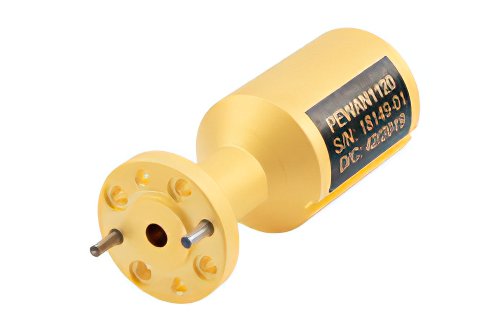
Dolph Waveguide high power termination is manufactured by casting with fins. The special heat-resistant absorbing material and heat emission mechanical design improve the overall capability. Dolph Microwave rectangular and double ridge waveguide termination models frequency are covering from 1.10 GHz to 50GHz, Features with high stability, good accuracy and fast response. The termination loads offer

4.64-7.05GHz, Waveguide High Power Termination 750W. Read More »

Millimeter Wave Products Processing by Dolph-Microwave

In the millimeter wave industry, waveguides are an important component that can transmit high-frequency signals from one point to another with minimal signal loss. A waveguide is a hollow metallic or dielectric structure that confines and guides electromagnetic waves within its boundaries. Its high power handling capabilities, low attenuation and low dispersion make it ideal

Millimeter Wave Products Processing by Dolph-Microwave Read More »

What are the frequency ranges for different frequency bands in circular waveguides

The frequency range of circular waveguides in different frequency bands varies according to their diameter. For example, in TE11 mode, a circular waveguide with a diameter of 22.86 mm operates at 7.3-10 GHz. Choose the appropriate diameter to match the required frequency range to ensure low-loss transmission. S-Band Characteristics At 3AM, ESA alerted us about

What are the frequency ranges for different frequency bands in circular waveguides Read More »

Scroll to Top
Blank Form (#3)