
GSM antennas operate at lower frequencies (900/1800 MHz) for mobile communication, while microwave antennas use higher bands (2-60 GHz) for long-distance data links. GSM antennas have omnidirectional coverage (360°), whereas microwave antennas focus signals directionally (5°-30° beamwidth). Microwave antennas require precise alignment (±1° accuracy) for optimal performance, unlike GSM antennas’ plug-and-play installation.
Table of Contents
Size and Shape Differences
GSM antennas and microwave antennas look and perform differently because they’re built for distinct purposes. A typical GSM antenna is shorter (0.3m to 1.2m) and slimmer (2cm to 10cm diameter), designed mainly for mobile communication in the 900MHz to 2.1GHz range. In contrast, microwave antennas are bulkier (0.5m to 3m in diameter) and often dish-shaped, optimized for high-frequency signals (6GHz to 80GHz) used in long-distance backhaul links. The weight difference is significant—GSM antennas usually weigh 1kg to 5kg, while microwave dishes can exceed 15kg due to their rigid parabolic reflectors.
The shape directly affects performance. GSM antennas often use omnidirectional or sectorial designs to cover wide areas (up to 35km in rural zones), while microwave antennas rely on highly directional parabolic or horn designs to focus signals over 50km+ distances with minimal loss. A 2.4GHz GSM antenna might have a 70° horizontal beamwidth, whereas a 24GHz microwave dish could narrow it down to 3°-5° for precision.
| Feature | GSM Antenna | Microwave Antenna |
|---|---|---|
| Typical Length | 0.3m–1.2m | 0.5m–3m (dish diameter) |
| Weight | 1kg–5kg | 10kg–30kg |
| Beamwidth | 60°–120° (omnidirectional) | 3°–10° (highly directional) |
| Frequency | 900MHz–2.1GHz | 6GHz–80GHz |
| Coverage | Up to 35km | 50km–100km+ |
Material choices also differ. GSM antennas often use lightweight fiberglass or PVC housing to resist weather without adding bulk, while microwave dishes require aluminum or steel frames to maintain structural integrity under wind loads up to 150 km/h. The larger surface area of microwave dishes (e.g., 1.2m² for a 1.2m dish) increases wind resistance, demanding stronger mounting poles (minimum 50mm diameter steel) compared to GSM setups (often 25mm–40mm).
Installation flexibility varies too. A GSM antenna can be mounted on a 2-inch pole with simple brackets, whereas a microwave dish needs heavy-duty tilt-and-swivel mounts to align its narrow beam within ±0.5° accuracy. Misalignment by just 1° at 30GHz can cause a 30% signal drop, making precise shaping critical.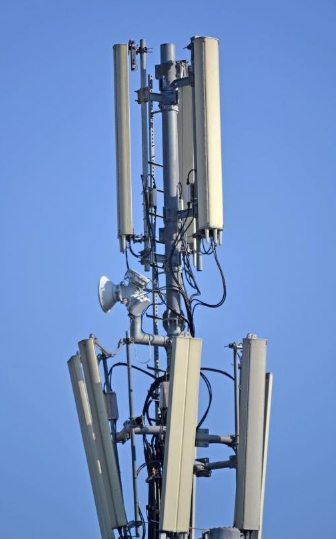
Frequency Range Uses
GSM and microwave antennas operate in completely different frequency bands, which directly impacts their real-world applications. GSM antennas typically handle 850MHz to 2.1GHz, covering 2G, 3G, and 4G mobile networks, while microwave antennas work in much higher ranges—6GHz to 80GHz—for point-to-point backhaul, satellite links, and radar systems. The lower frequencies of GSM (e.g., 900MHz) travel farther (up to 35km) but carry less data (max ~100Mbps per channel), whereas microwave frequencies (e.g., 28GHz) support 10Gbps+ speeds but struggle beyond 5km without repeaters due to atmospheric absorption.
A key difference is spectrum efficiency. GSM antennas use 200kHz to 5MHz channel bandwidths for voice and mobile data, while microwave systems allocate 50MHz to 2GHz-wide channels for high-capacity transport. For example, a 4G LTE antenna at 1.8GHz might deliver 75Mbps over a 10MHz channel, but a 70GHz microwave link with 1GHz bandwidth can push 40Gbps. Rain fade becomes a major issue above 10GHz—at 38GHz, heavy rainfall (50mm/h) can attenuate signals by 15dB/km, forcing operators to reduce link distances or increase transmit power (often 20dBm to 30dBm).
Here’s how the frequency ranges break down in practice:
| Parameter | GSM Antenna | Microwave Antenna |
|---|---|---|
| Primary Bands | 850MHz, 900MHz, 1.8GHz, 2.1GHz | 6GHz, 18GHz, 23GHz, 38GHz, 70GHz |
| Typical Use Case | Cellular voice/data coverage | Fiber backup, military comms, ISP backhaul |
| Max Data Rate | 100Mbps (4G) / 3Gbps (5G) | 10Gbps–100Gbps (E-band) |
| Range | 5km–35km (rural) | 1km–50km (depends on frequency) |
| Rain Fade Impact | Negligible below 3GHz | Up to 25dB/km loss at 80GHz |
Interference handling also diverges. GSM antennas deal with co-channel interference from nearby towers (e.g., -85dBm noise floor), relying on frequency hopping and 3GPP protocols to mitigate congestion. Microwave links, however, face adjacent-channel interference in crowded bands like 18GHz, where 1MHz misalignment can cause 20% throughput loss. To combat this, operators use cross-polarization (XPD >30dB) or adaptive modulation (e.g., 256QAM dropping to QPSK during storms).
Licensing costs add another layer. GSM spectrum is auctioned at ~$0.50–2 per MHz/pop (population coverage), making nationwide deployments expensive (e.g., $20B for 100MHz in the U.S.). Microwave bands are cheaper ($500–5,000 per link/year) but require precise coordination to avoid clashes. A single 23GHz link might cost $1,200 annually, while a 70GHz unlicensed link avoids fees but sacrifices reliability.
Latency is another critical factor. GSM networks introduce 50ms–200ms delay due to processing layers (e.g., RNC, core nodes), but microwave backhaul cuts this to 0.25ms per km—crucial for stock trading or 5G fronthaul (<1ms total). However, higher frequencies demand stricter alignment: a 38GHz beam 0.5° off-axis loses 40% signal strength at 10km, versus just 10% loss for a 2.1GHz GSM sector antenna.
Installation Methods Compared
Installing a GSM antenna versus a microwave antenna is like comparing a weekend DIY project to a precision engineering task. A standard GSM antenna can be mounted in under 2 hours by a two-person crew, requiring just a 3-inch diameter pole, basic tools, and a compass for rough alignment (within 10° tolerance). In contrast, a microwave dish demands 4–8 hours of work, heavy equipment (e.g., cranes for dishes >1.5m), and sub-degree alignment accuracy using laser sights or GPS-aided theodolites. The cost difference reflects this: GSM installations run 800 per site, while microwave setups range from 15,000 depending on tower height and terrain.
Structural requirements vary drastically. GSM antennas weighing under 5kg can hang off existing structures like rooftops or streetlights with M8–M12 bolts, whereas a 30kg microwave dish needs a steel tower rated for 150km/h winds with foundation bolts at least 20mm thick. For rooftop mounts, GSM units add <15kg/m² load, but microwave dishes exert >50kg/m²—forcing structural reinforcements costing 200 per square meter.
| Factor | GSM Antenna | Microwave Antenna |
|---|---|---|
| Installation Time | 1–2 hours | 4–8 hours |
| Crew Size | 2 people | 3–5 people (incl. riggers) |
| Alignment Tolerance | ±10° (azimuth) | ±0.5° (azimuth & elevation) |
| Mounting Hardware | 25–50mm pole clamps | 75–150mm heavy-duty brackets |
| Wind Load Rating | Up to 120km/h | 150–200km/h (hurricane-grade) |
| Typical Height | 10m–30m | 30m–100m (avoiding obstructions) |
Environmental factors play a bigger role for microwave links. While GSM antennas tolerate ±15°C temperature swings with minimal performance drift, microwave dishes expand/contract 0.5mm per 10°C change—enough to misalign a 38GHz beam over 300m distances. Installers compensate with thermal expansion joints and auto-tracking systems that adjust alignment every 5 minutes (costing 20,000 per link).
Cabling complexity differs too. GSM setups use low-loss coaxial cables (7–13mm diameter, 3dB/100m attenuation at 2GHz), often routed haphazardly. Microwave installations require waveguide or hybrid fiber (0.5dB/100m loss at 70GHz), meticulously grounded every 3 meters to prevent interference. Labor for microwave cabling runs 150 per meter versus 30/m for GSM.
Regulatory hurdles add delays. GSM deployments in urban areas often just need 1–3 day permits, but microwave links require FCC/ITU coordination (4–12 weeks) to avoid interfering with existing systems. A single 23GHz link might need 20+ pages of interference analysis, while GSM sites get blanket approvals.
In practice, a telecom operator can deploy 50 GSM antennas in the time it takes to commission one 80GHz microwave link. But for backbone networks needing 99.999% uptime, the microwave’s precision pays off—alignment errors cause 70% of microwave failures, versus just 15% for GSM. Next, we’ll summarize how these differences dictate real-world use cases.