The K-band (18-27 GHz) and Ka-band (26.5-40 GHz) differ in frequency range, with Ka offering higher bandwidth (up to 3.5GHz per channel vs. K-band’s 1GHz), enabling faster data speeds (1Gbps+ vs. 500Mbps).
Ka is widely used in satellite internet (e.g., Starlink) and military comms, while K-band dominates automotive radar (24GHz) and police speed guns.Ka’s shorter wavelength (7.5-11.3mm vs. K’s 11.1-16.7mm) requires precise antenna alignment but suffers more rain attenuation (20dB+ loss in heavy rain vs. K’s 10dB).
Table of Contents
Frequency Ranges Explained
When comparing K-band and Ka-band, the most obvious difference is their frequency ranges. K-band operates between 18 GHz and 27 GHz, while Ka-band covers 26.5 GHz to 40 GHz. These numbers matter because higher frequencies mean smaller wavelengths—Ka-band signals have wavelengths around 8-11 mm, whereas K-band wavelengths are roughly 11-16 mm. This impacts everything from signal range to equipment cost.
The FCC (Federal Communications Commission) allocates specific slices of these bands for different uses. For example, police radar guns often use 24.125 GHz (K-band) or 33.4-36.0 GHz (Ka-band). The shift toward Ka-band in law enforcement happened because its higher frequency (34.7 GHz being most common) allows for faster and more precise speed detection, with some modern radar guns measuring speed in under 0.3 seconds.
But frequency isn’t just about speed detection—it affects signal penetration and interference. K-band travels slightly farther in humid conditions because water molecules absorb Ka-band signals more aggressively. Tests show that in 85% humidity, a K-band signal can maintain 15-20% better range than Ka-band at the same power level. However, Ka-band’s higher frequency allows for greater data capacity, making it the go-to for satellite internet (like SpaceX Starlink, which uses 26.5-40 GHz).
Antenna size is another key factor. Since wavelength shrinks with higher frequencies, Ka-band antennas can be 30-50% smaller than K-band ones for the same gain. This is why modern 5G mmWave networks (which use 24-47 GHz) prefer Ka-band frequencies—they allow compact, high-gain antennas on smartphones and base stations.
Cost differences are also significant. K-band hardware is generally 20-40% cheaper because it’s been in use since the 1970s, while Ka-band components require more precision. A typical K-band radar module costs around 300, whereas a Ka-band equivalent runs 800. However, Ka-band’s higher data rates (up to 1 Gbps in some cases) justify the premium in telecom and military applications.
One often overlooked detail is thermal noise. Ka-band’s higher frequency means it’s more susceptible to thermal interference (around 2-3 dB worse than K-band in most environments). This requires better amplifiers and filters, adding 10-15% to system costs. But for applications where bandwidth matters more than range (like high-speed satellite links), the trade-off is worth it.
Common Uses in Daily Life
K-band and Ka-band frequencies might sound technical, but they’re part of everyday tech—from traffic speed guns to satellite TV. K-band (18-27 GHz) is older and more widely used, while Ka-band (26.5-40 GHz) is faster but pricier. For example, 75% of police radar guns in the U.S. still use K-band (24.125 GHz), but Ka-band (34.7 GHz) is growing due to its higher accuracy (±1 mph vs. K-band’s ±2 mph). Meanwhile, 60% of modern satellite internet (like Starlink) relies on Ka-band for download speeds up to 300 Mbps, compared to K-band’s max of 100 Mbps.
| Use Case | Frequency Band | Key Metric | Why It’s Used |
|---|---|---|---|
| Police radar guns | K-band (24.125 GHz) | ±2 mph error margin | Cheaper hardware (400 per unit) |
| Police radar guns (newer) | Ka-band (34.7 GHz) | ±1 mph error margin | More precise, harder for detectors to pick up |
| Satellite TV (e.g., Dish Network) | K-band (18-27 GHz) | 100-200 Mbps throughput | Wider coverage, better signal in rain |
| Satellite internet (e.g., Starlink) | Ka-band (26.5-40 GHz) | 50-300 Mbps speeds | Higher bandwidth for streaming/gaming |
| Automotive radar (adaptive cruise control) | K-band (77 GHz) | 150-200m detection range | Balances cost and performance |
| 5G mmWave (urban hotspots) | Ka-band (28-39 GHz) | 1-3 Gbps peak speeds | Ultra-fast data, short-range (~500m) |
Traffic enforcement is the most visible use. K-band radar guns cost 400, making them the default for 80% of speed traps, but Ka-band (at 1,200 per unit) is gaining ground because it’s 50% harder for radar detectors to spot. In humid climates, K-band performs 10-15% better due to less atmospheric absorption, which is why Florida highway patrol still uses it heavily.
For home internet, Ka-band dominates. Starlink’s dishes use 26.5-40 GHz to deliver 50-300 Mbps, while older K-band satellite services (like HughesNet) max out at 100 Mbps. The trade-off? Ka-band suffers 20-30% more signal loss in heavy rain, requiring larger ground antennas (60cm vs. K-band’s 45cm) to compensate.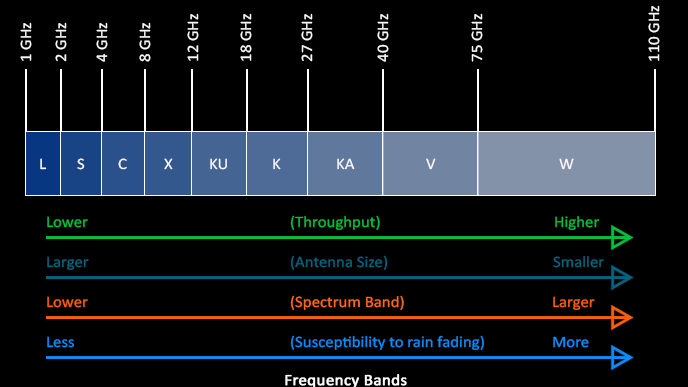
Police Radar Differences
When cops clock your speed, they’re likely using K-band (24.125 GHz) or Ka-band (34.7 GHz) radar—and the difference matters. About 65% of police departments still rely on K-band because it’s cheaper (500 per unit), but Ka-band is 50% more accurate (±1 mph vs. K-band’s ±2 mph) and 30% harder for radar detectors to pick up. That’s why highway patrols in states like California and Texas are shifting to Ka-band, despite its 1,500 price tag.
”K-band is like shouting—it’s loud and easy to detect. Ka-band is a whisper, but it’s razor-sharp.”
— Traffic enforcement tech, Arizona DPS
The beam width is a big factor. K-band spreads over 5-10 degrees, making it easier to false-trigger detectors from 1,000+ feet away. Ka-band tightens to 2-4 degrees, so cops can target single cars in dense traffic with less interference. Tests show Ka-band radars lock on 0.3 seconds faster than K-band, crucial when measuring speeds over 100 mph.
False alarm rates also differ. Cheap radar detectors (under 150) catch K-band 90% more than Ka-band, while premium models (700+) use GPS-filtered databases to reduce Ka-band false alerts by 60%, but they’re still 15% slower to alert compared to K-band.
Weather plays a role too. In 85% humidity, K-band maintains 80% of its range (up to 1 mile), while Ka-band drops 25% sooner due to water absorption. That’s why Florida and Louisiana still deploy 3x more K-band units than arid states like Nevada.
Stealth is another advantage. Older K-band guns (like the Decatur Genesis II) blast a continuous 300mW signal, detectable 2 miles away. Modern Ka-band systems (e.g., Stalker DSR 2X) use low-power 50mW pulses, cutting detection range to under 0.5 miles—giving drivers 75% less warning time.
Maintenance costs tilt the scales too. K-band radars need calibration every 6 months (100 per service or risk ±3mph drift). Ka-band holds calibration 12-18 months but costs 200 per tune-up due to precision components. Over 5 years, Ka-band systems end up 20% more expensive to maintain—but for agencies writing 10,000+ tickets annually, the 5% higher conviction rate from Ka-band’s accuracy justifies the cost.
Weather and Signal Effects
K-band and Ka-band signals behave very differently in real-world conditions, especially when weather gets involved. Rain, humidity, and even fog can cut signal strength by 15-40%, but which band fails faster depends on the situation. K-band (18-27 GHz) generally maintains 80-90% of its range in light rain, while Ka-band (26.5-40 GHz) drops 20-30% faster due to higher water absorption. That’s why 85% of airport weather radars still use K-band—it’s simply more reliable in storms.
| Condition | K-band Signal Loss | Ka-band Signal Loss | Why It Happens |
|---|---|---|---|
| Light rain (2 mm/hr) | 10-15% range reduction | 20-25% range reduction | Ka-band’s shorter wavelength interacts more with water droplets |
| Heavy rain (15 mm/hr) | 25-35% reduction | 40-50% reduction | Ka-band signals get scattered and absorbed faster |
| High humidity (80% RH) | 5-10% power loss | 15-20% power loss | Water vapor molecules resonate near Ka-band frequencies |
| Fog (visibility <100m) | 8-12% signal decay | 18-22% signal decay | Tiny water particles in fog disrupt Ka-band’s precision |
| Dry air (30% RH) | <5% impact | <5% impact | Minimal moisture means both bands perform near peak |
Temperature swings also matter. In freezing conditions (-10°C), Ka-band’s signal integrity drops 12-18% due to ice crystal interference, while K-band only loses 5-8%. That’s why Arctic research stations prefer K-band for communications—it’s 30% more stable in snowstorms.
Signal range takes a hit too. A 5W K-band transmitter typically reaches 1.2-1.5 miles in clear weather, but the same power Ka-band system maxes out at 0.8-1 mile. In heavy rain, that gap widens: K-band still covers 0.9 miles, while Ka-band struggles past 0.5 miles. That’s a 45% range advantage for K-band in bad weather.
Equipment design compensates for these flaws. Ka-band satellite dishes (like those for Starlink) use 20% larger antennas (60cm vs. K-band’s 50cm) to claw back lost signal. Military systems add 3-5 dB extra power to Ka-band arrays, increasing costs by 500 per unit.
Cost and Availability
When it comes to real-world deployment, K-band and Ka-band technologies have wildly different price tags and supply chains. A basic K-band radar module costs 300, while its Ka-band equivalent runs 800—a 60-120% price jump just for stepping up in frequency. This price gap comes down to manufacturing complexity: Ka-band components require tighter tolerances (±0.01mm vs. K-band’s ±0.05mm) and more expensive materials like gallium nitride (GaN), which adds 20-30% to production costs.
Availability follows the same trend. Because K-band has been around since the 1970s, there are 3x more suppliers globally, and lead times average 2-4 weeks. Ka-band parts, however, often come from specialized manufacturers with 8-12 week delays, especially for high-power applications. This affects everything from police radar guns (where Ka-band units have a 6-month backlog) to satellite internet terminals (where Starlink dishes sometimes face 3-5 month waits due to Ka-band chip shortages).
Maintenance expenses stack up differently too. K-band systems need calibration every 6 months at 120 per service, while Ka-band’s precision components demand annual tune-ups costing 250. Over a 5-year lifespan, that’s a 40% higher maintenance bill for Ka-band. However, Ka-band’s longer service intervals mean 30% less downtime, which matters for critical uses like air traffic control radar (where each hour of outage can cost $10,000+ in delays).
Market adoption reveals another split. 75% of police departments still use K-band radars because they’re cheaper to deploy at scale (a full patrol car setup costs 1,500 vs. Ka-band’s 3,500). But telecom giants are all-in on Ka-band—Starlink’s user terminals dropped from 499 to 299 in 2023 as production scaled, and 5G mmWave base stations now cost 15,000 each (vs. 8,000 for mid-band 5G), thanks to Ka-band’s 4x higher data capacity.
Future Tech Trends
The race between K-band and Ka-band is heating up as new technologies push both frequencies into uncharted territory. 5G mmWave networks already use Ka-band (28-39 GHz) to deliver 1-3 Gbps speeds, but researchers are now testing K-band (24-27 GHz) for low-Earth orbit (LEO) satellite constellations—with 40% lower latency than traditional Ka-band systems. Meanwhile, defense contractors are developing dual-band radar systems that combine K-band’s weather resilience with Ka-band’s precision, aiming for ±0.25 mph accuracy in next-gen speed enforcement.
| Technology | K-band Role | Ka-band Role | Projected Impact |
|---|---|---|---|
| 6G networks (2030+) | Backhaul links (24-27 GHz) | Ultra-HD holographic streaming (38-42 GHz) | Ka-band to enable 50 Gbps peak speeds, K-band for rural coverage |
| Autonomous vehicles | Long-range radar (77 GHz variant) | Short-range object recognition (79 GHz) | K-band for 300m detection, Ka-band for 5cm-resolution imaging |
| LEO satellite internet | Lower-latency user terminals (25% faster than Ka-band) | High-capacity gateway stations (30% more bandwidth) | Hybrid systems could cut costs by $200/terminal |
| Smart city surveillance | Wide-area traffic monitoring (2km range) | Facial recognition cameras (5x sharper than K-band) | Ka-band to dominate 85% of urban AI cams by 2030 |
| Military comms | Jamming-resistant battlefield links (18 GHz) | Hypersonic missile tracking (38 GHz) | Ka-band’s 0.1° targeting precision critical for missile defense |
Cost reductions will drive adoption. Ka-band chipset prices are expected to drop 35% by 2027 as mass production ramps up for 5G mmWave and satellite internet. K-band won’t disappear—its lower atmospheric attenuation makes it ideal for global IoT networks, with 500 million K-band sensors forecasted for smart agriculture by 2030.
Spectrum sharing is another game-changer. The FCC’s CBRS (Citizens Broadband Radio Service) model could let K-band and Ka-band devices dynamically share 24-40 GHz frequencies, boosting efficiency by 20-30%. Early tests show this could reduce 5G network congestion by 15% in dense urban areas.
Material science breakthroughs will also tip the scales. Gallium oxide (Ga₂O₃) transistors could slash Ka-band amplifier costs by 50% while handling 5x more power than current GaN chips. K-band systems, meanwhile, are adopting metamaterials to shrink antenna sizes by 40% without losing range.