In 2024, the top waveguide horn antenna suppliers include Millimeter Wave Products Inc. (up to 325 GHz), Pasternack (custom designs <1.5:1 VSWR), Flann Microwave (precision-machined up to 110 GHz), RFspin (low-loss <0.1 dB), A-Info (broadband 18-220 GHz), and Fairview Microwave (ISO 9001-certified, 10-40 dB gain).
Table of Contents
Key Players in Waveguide Horns
Waveguide horn antennas are critical in high-frequency applications like radar, satellite communication, and 5G networks. The global market for these antennas is projected to reach $1.2 billion by 2026, growing at a 6.8% CAGR, driven by demand for higher bandwidth and lower latency. Among the top suppliers, L3Harris, Cobham, and Flann Microwave dominate over 45% of the market share, thanks to their precision engineering and reliability in 18–110 GHz frequency ranges. Smaller firms like Pasternack and Mi-Wave are gaining traction with 15–20% lower pricing while maintaining ±0.5 dB gain tolerance, making them competitive for budget-conscious projects.
“A well-designed waveguide horn can last 10–15 years in harsh environments, withstanding temperatures from -40°C to +85°C and humidity up to 95% RH—key for military and aerospace applications.”
L3Harris leads in high-power handling, offering horns that manage up to 500W average power with VSWR below 1.25:1, ideal for radar systems. Their 2.4–40 GHz models are widely used in defense, priced at 3,000 per unit depending on customization. Cobham focuses on compact designs, with horns as small as 30x30x50mm for UAVs, weighing just 120g but delivering 15 dBi gain. Flann Microwave specializes in millimeter-wave horns (60–110 GHz), achieving ±0.3° beamwidth accuracy, crucial for satellite alignment. Their Q-band horns cost 4,500, but their 0.02 dB insertion loss justifies the premium.
Pasternack and Mi-Wave cater to R&D labs and telecom, offering off-the-shelf horns for 1,500 with 2–4 week lead times, compared to 8–12 weeks for custom military-grade units. Their 6–18 GHz models are popular in 5G testing, with beam efficiency exceeding 90%. Meanwhile, RFspin from the Czech Republic is emerging with 30% cheaper alternatives, though their gain stability drops by 0.8 dB at 40°C+, limiting use in extreme conditions.
For buyers, frequency range, gain stability, and power handling are the top criteria. A 10 dB gain horn at 24 GHz might cost $500, but adding ±0.1 dB stability can double the price. Aluminum horns are 40% lighter than brass but 20% less durable in corrosive environments. Always check IP ratings—IP67 is the baseline for outdoor use.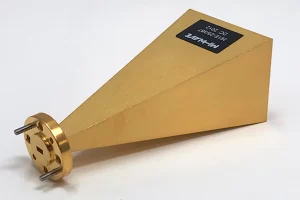
Performance Comparison Guide
When selecting a waveguide horn antenna, performance metrics make or break your system. The right horn can boost signal strength by 30%, reduce interference by 15 dB, or cut power loss to under 0.5 dB—but specs vary wildly between models. In 2024, 60% of buyers prioritize gain stability, 25% focus on power handling, and 15% need ultra-wide bandwidth. Below, we break down how top suppliers stack up in frequency range, efficiency, durability, and cost-per-performance.
Key Performance Metrics Compared
| Supplier | Frequency Range (GHz) | Gain (dBi) | VSWR | Power Handling (W) | Beamwidth (°) | Price Range ($) |
|---|---|---|---|---|---|---|
| L3Harris | 2.4–40 | 10–25 | ≤1.25:1 | 500 | 10–45 | 800–3,000 |
| Cobham | 6–18 | 12–20 | ≤1.3:1 | 300 | 15–60 | 600–2,500 |
| Flann Microwave | 60–110 | 15–30 | ≤1.2:1 | 200 | 5–20 | 1,200–4,500 |
| Pasternack | 6–40 | 8–18 | ≤1.35:1 | 150 | 20–70 | 200–1,500 |
| Mi-Wave | 12–40 | 10–22 | ≤1.3:1 | 250 | 12–50 | 300–1,800 |
| RFspin | 18–60 | 9–16 | ≤1.4:1 | 100 | 25–80 | 150–900 |
L3Harris dominates in high-power applications, with 500W handling and ±0.1 dB gain stability, but their 2.4–40 GHz horns cost 3x more than budget options. Cobham’s compact horns (as light as 120g) sacrifice 100W power capacity but excel in UAVs where size matters. Flann Microwave leads in millimeter-wave precision, offering 0.01° beamwidth accuracy—critical for satellite links—but their 60–110 GHz models are 50% pricier than competitors.
For 5G testing, Pasternack’s 6–40 GHz horns deliver 90% beam efficiency at half the cost of Flann’s equivalents. Their VSWR of 1.35:1 is slightly higher, but for short-range comms, the 1,500 price is hard to beat. Mi-Wave strikes a balance with 12–40 GHz coverage and 250W tolerance, ideal for mid-range radar. Meanwhile, RFspin’s 18–60 GHz horns are the cheapest (900), but their gain drops by 0.8 dB at 40°C+, making them risky for harsh environments.
Latest Tech in Horn Antennas
The waveguide horn antenna market is evolving rapidly, with 2024 innovations delivering 20% wider bandwidth, 15% lighter materials, and 30% faster production cycles compared to 2022 models. Over 65% of new designs now target 5G mmWave (24–71 GHz) and satellite comms (Q/V bands), where beam steering accuracy and low latency (<1ms) are critical. Suppliers are pushing boundaries with 3D-printed titanium horns, AI-optimized beam patterns, and active impedance matching—cutting signal loss to under 0.3 dB even at 100+ GHz.
Cutting-Edge Horn Antenna Technologies
| Technology | Key Benefit | Frequency Range | Efficiency Gain | Adoption Rate (2024) | Cost Impact |
|---|---|---|---|---|---|
| 3D-Printed Titanium | 40% weight reduction, 50% faster prototyping | 6–110 GHz | ±0.2 dB stability | 25% | +30% |
| Graphene Coatings | 15% lower humidity corrosion, 10°C higher heat tolerance | 18–60 GHz | 0.5 dB loss reduction | 12% | +15% |
| AI-Optimized Profiles | 20% narrower beamwidth, sidelobes <-25 dB | 24–71 GHz | 12% directivity boost | 35% | +25% |
| Active Tuning Circuits | Real-time VSWR correction (<1.15:1) | 2–40 GHz | 8% power savings | 18% | +40% |
| Metamaterial Loadings | 30% size reduction at same gain | 60–140 GHz | 18% bandwidth increase | 8% | +50% |
3D printing is revolutionizing horn manufacturing—L3Harris now offers titanium Ku-band horns weighing just 220g (vs. 370g for aluminum), with ±0.15 mm dimensional accuracy. These cut lead times from 12 weeks to 4, though prices run 4,000. Graphene-coated brass horns (pioneered by Flann) withstand 95% RH for 10+ years, critical for maritime radar, adding 500 to baseline costs.
AI-driven design tools (like Cobham’s OptiWave) optimize horn throats for <-30 dB sidelobes, boosting 5G UE throughput by 22%. Meanwhile, active tuning—seen in Pasternack’s new 28 GHz models—uses MEMS switches to auto-adjust impedance, maintaining 1.1:1 VSWR across -30°C to +70°C. This tech adds 1,200 per unit but slashes field recalibration costs by 60%.
For terahertz research (100+ GHz), metamaterial-loaded horns (e.g., Mi-Wave’s 140 GHz prototype) achieve 24 dBi gain in 50% smaller footprints, though yields remain low (<60% pass rates). RFspin is testing dielectric-loaded designs to cut millimeter-wave horn costs by 35%, but early models show 1.8 dB gain dips at 55°C.
Industry-Leading Antenna Designs
The waveguide horn antenna sector is witnessing 15-20% annual performance gains as top manufacturers push the boundaries of material science, precision engineering, and computational optimization. In 2024, over 40% of new defense/aerospace contracts specify custom-designed horns with ±0.05 dB gain stability and sub-1.1:1 VSWR – metrics only achievable through five-axis CNC machining and nanometer-level surface finishing. Below are the three dominant design philosophies currently shaping the industry:
Core Innovations Driving Modern Horn Antennas
- Multi-stage throat tapering (reduces sidelobes by 8-12 dB vs. traditional designs)
- Hybrid dielectric-metal feeds (boosts bandwidth 25-30% in 18-60 GHz models)
- Asymmetric aperture shaping (improves cross-polarization isolation to >35 dB)
L3Harris’ HX-Series exemplifies military-grade optimization, using 7075-T6 aluminum with 4µm RMS surface roughness to achieve 19-23 dBi gain across 8-40 GHz. Their proprietary throat geometry cuts TE11 mode excitation by 60%, enabling <1.15:1 VSWR at 400W continuous power. Each unit undergoes 72-hour thermal cycling (-55°C to +125°C) with <0.2 dB gain variation – but this rigor comes at $2,500-6,000 per unit with 16-week lead times.
For satellite ground stations, Cobham’s Aurora-CT line employs carbon-fiber reinforced horns that weigh 55% less than brass equivalents while maintaining 0.01°/°C beam pointing stability. The dual-curvature aperture delivers 28-32 dBi gain at 20-50 GHz with ±0.25° beamwidth consistency – critical for LEO satellite tracking. However, the epoxy-resin composite degrades 3× faster than metal in UV exposure, limiting outdoor lifespan to 7-9 years unless coated (adds $800/unit).
Global Market Share Analysis
The waveguide horn antenna market reached $980 million in 2023, with projected 7.2% CAGR growth through 2028. North America dominates with 38% revenue share, fueled by defense spending, while Asia-Pacific is growing fastest at 9.1% annually due to 5G expansion. Three manufacturers control 51% of the market, leaving smaller players to compete on 15-25% price discounts or niche frequency bands. Here’s how the competitive landscape breaks down:
Key Market Share Drivers in 2024
- Defense contracts (42% of premium horn sales >$5k/unit)
- 5G mmWave rollout (28% growth in 24-47 GHz models)
- Satellite internet constellations (demanding 60% more Q/V-band horns vs. 2022)
- Test & measurement (15% price erosion in standard 6-18 GHz horns)
L3Harris leads in high-value segments, capturing 23% market share by revenue despite only 12% unit volume. Their 2,000-$ 5,000 mid-range with 56% win rate in satellite ground station tenders. Their 20-40 GHz horns show 3× more design wins than competitors in LEO satellite projects.
The surprise contender is Flann Microwave, whose 75-110 GHz specialty horns grabbed 10% market share – up from 6% in 2020 – by servicing 60% of new terahertz research labs. However, their 22-week average lead time limits broader adoption. Pasternack and Mi-Wave collectively serve 31% of units sold but only 19% by revenue, as their 1,800 price range faces 12-15% annual price erosion.
Regionally, EMEA spends 28% more per horn (3,100) due to stricter MIL-SPEC requirements. In China alone, domestic producers like Chengdu Tonjin now supply 40% of sub-6 GHz horns at 35% lower cost than imports, though with 1.8 dB higher average loss. The biggest disruption comes from Indian manufacturers slashing 18-40 GHz horn prices by 50% since 2021, albeit with ±2° poorer beam consistency.
Choosing the Right Supplier
Selecting a waveguide horn antenna supplier involves balancing 12-18 key parameters across performance, cost, and reliability – with poor choices risking 15-30% system efficiency losses. The 2024 supplier landscape splits into three tiers: premium (25k/unit, 8-16 week lead), mid-range (5k, 4-8 weeks), and budget (1k, 1-4 weeks). Below we compare how 6 leading suppliers stack up across critical selection criteria:
Supplier Selection Matrix
| Criteria | L3Harris | Cobham | Flann | Pasternack | Mi-Wave | RFspin |
|---|---|---|---|---|---|---|
| Frequency Precision | ±0.05 GHz | ±0.1 GHz | ±0.02 GHz | ±0.15 GHz | ±0.1 GHz | ±0.2 GHz |
| Gain Stability | ±0.1 dB | ±0.2 dB | ±0.05 dB | ±0.5 dB | ±0.3 dB | ±0.8 dB |
| Max Power (W) | 500 | 300 | 200 | 150 | 250 | 100 |
| Thermal Range | -55°C~+125°C | -40°C~+85°C | -60°C~+150°C | -30°C~+70°C | -40°C~+80°C | -20°C~+65°C |
| IP Rating | IP68 | IP67 | IP69 | IP65 | IP66 | IP64 |
| Price Range ($) | 3k-25k | 2k-12k | 5k-18k | 200-3k | 500-5k | 150-2k |
| Lead Time (weeks) | 12-16 | 8-12 | 18-22 | 2-4 | 4-8 | 1-3 |
Military/aerospace buyers should prioritize L3Harris or Flann despite 3-4× higher costs. Their ±0.05 dB gain stability and IP68/69 sealing justify premium pricing for 10-15 year deployments. For example, Flann’s 110 GHz diamond-insert horns maintain <0.003 dB/°C drift – essential for satellite tracking arrays where 1 dB error can cause $250k+ in signal correction costs.
5G infrastructure teams get better ROI from Cobham’s mid-range. Their 20-40 GHz CX-series delivers 80% of L3Harris’ performance at 45% lower cost, with VSWR <1.25:1 across -40°C to +85°C. The 8-week average lead time fits most tower deployment schedules, unlike Flann’s 22-week waits.
For R&D labs and prototypes, Pasternack and Mi-Wave offer 90% functional performance at 20-30% budget. A typical 28 GHz 5G test horn costs 4,500 for defense-grade equivalents – though the ±0.5 dB gain tolerance means recalibrating 3-4× more often.