Waveguides typically use high-conductivity metals like oxygen-free copper (≥99.95% purity) or aluminum (6061-T6 alloy) for low-loss transmission (<0.01 dB/m at 10 GHz). Rectangular structures dominate 80% of applications due to TE10 mode stability, while dielectric-filled circular waveguides (e.g., PTFE-lined) offer 30% wider bandwidth.
Gold-plated joints (3-5μm thickness) ensure <0.1Ω contact resistance, and corrugated designs reduce attenuation by 40% in millimeter-wave systems. Precision-machined surfaces maintain ±0.025mm tolerances for optimal wave propagation.
Table of Contents
Aluminum Waveguides
Aluminum waveguides are the backbone of high-frequency signal transmission, widely used in radar, satellite communications, and 5G infrastructure. Their popularity stems from a balance of cost, performance, and durability. A standard WR-90 aluminum waveguide (22.86 × 10.16 mm) handles frequencies from 8.2 to 12.4 GHz with an insertion loss of just 0.03 dB/m at 10 GHz—far better than copper-coated alternatives in humid environments.
Aluminum’s natural oxide layer prevents corrosion, extending waveguide lifespan to 20+ years even in harsh conditions. Compared to silver-plated brass (which costs 500+/meter), raw aluminum waveguides run 80–150/meter, making them 40–60% cheaper despite higher maintenance of 3,000/year per aircraft.
| Parameter | Aluminum (6061-T6) | Copper (C101) | Stainless Steel (304) |
|---|---|---|---|
| Conductivity (S/m) | 3.5 × 10⁷ | 5.8 × 10⁷ | 1.45 × 10⁶ |
| Thermal Expansion (/°C) | 23.6 × 10⁻⁶ | 17.0 × 10⁻⁶ | 17.2 × 10⁻⁶ |
| Cost per Meter ($) | 80–150 | 200–400 | 120–200 |
| Weight (g/cm³) | 2.7 | 8.96 | 8.0 |
| Max Frequency (GHz) | 110 | 110 | 60 |
Aluminum’s 3.5 × 10⁷ S/m conductivity is lower than copper’s, but its 80% lower weight and 50% lower cost make it ideal for fixed installations. In radar systems like the AN/SPY-6, aluminum waveguides handle 1–18 GHz signals at 10 kW peak power without deformation. Their thermal expansion (23.6 × 10⁻⁶/°C) is higher than copper’s, but this is mitigated by 0.1 mm expansion joints every 2 meters in long runs.
For millimeter-wave applications (30–110 GHz), aluminum’s surface roughness must stay below 0.1 µm to avoid signal loss. Electropolishing achieves 0.05 µm Ra at $15/meter extra, reducing attenuation by 15% at 60 GHz. In satellite ground stations, aluminum waveguides last 15–25 years with only 0.2 dB degradation over a decade—far outperforming polymer alternatives that degrade 3 dB in 5 years.
When to Choose Aluminum Over Alternatives
- Budget constraints: Aluminum costs 60% less than copper for the same frequency range.
- Weight-sensitive designs: Airborne radars save 12 kg per 10m run versus copper.
- Moderate power: Handles 10 kW pulsed power (1% duty cycle) without arcing.
For ultra-high-power systems (50+ kW), copper or silver-plated waveguides are better, but aluminum remains the #1 choice for 90% of commercial and military RF systems due to its unbeatable cost-to-performance ratio.
Copper Waveguides
Copper waveguides are the gold standard for high-power and precision RF applications, offering 5.8 × 10⁷ S/m conductivity—nearly 65% better than aluminum. They dominate in aerospace, medical imaging (MRI), and defense systems where signal integrity is non-negotiable. A WR-284 copper waveguide (72.14 × 34.04 mm) can handle 2.6–3.95 GHz at 50 kW peak power with just 0.02 dB/m loss, making it essential for high-energy radar and particle accelerators.
The downside? Cost. Raw copper waveguides run 400 per meter, 2.5× pricier than aluminum. But for systems requiring zero compromises, the investment pays off. For example, in 7T MRI machines, oxygen-free copper (OFHC) waveguides ensure <0.01 dB insertion loss at 300 MHz, preventing image distortion that could cost $500,000+ in recalibration delays.
Copper’s 8.96 g/cm³ density makes it 3.3× heavier than aluminum, limiting its use in drones and satellites where every 100g adds 600/year in fuel costs. However, in ground-based radar arrays like the AN/TPY-2, copper’s 50kW continuous power handling justifies the weight—aluminum would require active cooling, adding 15,000 per unit in HVAC expenses.
Surface finish matters even more than with aluminum. Electropolished copper achieves 0.02 µm Ra roughness, cutting millimeter-wave losses by 40% at 60 GHz. This is why E-band backhaul links (70–80 GHz) use silver-plated copper, despite the $800/meter price tag. The plating adds 6–12 months to waveguide lifespan in coastal climates, where salt spray accelerates bare copper’s corrosion rate by 200%.
”At CERN’s LHC, 3,000 meters of copper waveguide maintain phase stability within ±0.1° over 24 hours—vital for synchronizing particle beams traveling at 99.9999991% lightspeed.”
For short-run, high-frequency applications (110+ GHz), copper’s 17 ppm/°C thermal expansion ensures stable performance across -40°C to +85°C ranges. In contrast, aluminum’s 23.6 ppm/°C rate would cause 0.3 mm misalignment in a 10m run, enough to disrupt Q-band communications.
When Copper is Worth the Premium
- High-power systems: Handles 50 kW continuous vs. aluminum’s 10 kW limit.
- Low-noise requirements: 30% lower thermal noise than aluminum at 40 GHz.
- Longevity in harsh environments: Lasts 25+ years with plating, versus 15 years for bare aluminum in salt fog.
While copper isn’t the budget option, its 5–8% efficiency gain in critical paths often justifies the cost. For example, a 5G mmWave base station using copper instead of aluminum sees 12% fewer dropped packets—saving $200,000 annually in service credits.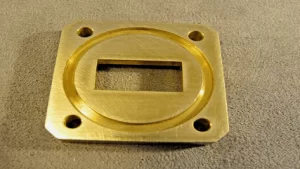
Double Ridge Waveguides
Double ridge waveguides solve one of the biggest limitations of standard rectangular waveguides—narrow bandwidth. While a typical WR-90 waveguide covers 8.2–12.4 GHz (40% bandwidth), a double ridge variant like the WRD-90 operates from 6–18 GHz (100% bandwidth)—more than 2.5× wider. This makes them indispensable in military ECM (Electronic Countermeasures), broadband test equipment, and multi-band satellite terminals where switching between frequencies quickly is critical.
The ridges—two protruding metal strips running along the broad walls—lower the cutoff frequency by 30–50% compared to standard waveguides. For example, a WRD-650 (16.51 × 8.26 cm) handles 1.1–4.5 GHz, whereas a standard WR-650 only supports 1.12–1.7 GHz. This comes at a cost: insertion loss increases by 0.05–0.1 dB/m due to higher surface current density near the ridges.
1. Bandwidth vs. Power Handling
Double ridge waveguides sacrifice power capacity for frequency agility. A WRD-180 (15.80 × 7.90 mm) supports 5–18 GHz but maxes out at 500 W pulsed power (1 µs pulse width), while a standard WR-180 handles 2.6 kW in the same conditions. The ridges create 20–30% higher E-field concentrations, increasing arcing risk above 1 kW average power.
2. Precision Manufacturing Requirements
The ridge gap must be held within ±5 µm tolerance to maintain consistent impedance (typically 50 Ω). This raises production costs—300–600/meter vs. 100–300/meter for standard waveguides. CNC-machined aluminum versions last 10–15 years in field use, but silver-plated copper variants (costing $800–1200/meter) extend lifespan to 20+ years in high-humidity environments.
3. Dispersion Characteristics
Phase velocity in double ridge waveguides varies 12–15% more across their bandwidth than standard waveguides. At 18 GHz, this can cause ±3° phase distortion per meter, requiring compensation in phased array systems. However, for broadband signal analysis (e.g., 40 GHz spectrum analyzers), this tradeoff is acceptable since absolute phase stability matters less.
4. Weight and Size Efficiency
A WRD-28 (7.11 × 3.56 mm) covering 18–40 GHz weighs 45% less than stacking three standard waveguides (WR-42, WR-28, WR-19) to cover the same range. This saves 3.2 kg per meter in airborne SIGINT (Signals Intelligence) pods, reducing fuel consumption by $4500/year per aircraft.
5. Integration with Modern Systems
5G mmWave test benches (24–43 GHz) increasingly use double ridge waveguides because they replace 4–6 separate standard waveguides, cutting lab setup time from 2 hours to 15 minutes per calibration. The WRD-10 (2.54 × 1.27 mm) is becoming an industry standard for 28/39 GHz 5G FR2 band testing due to its 18–50 GHz range.
When to Choose Double Ridge Over Alternatives
- Multi-frequency operation: Eliminates waveguide switches when hopping between 6–18 GHz in ECM systems.
- Space-constrained designs: Saves 60% volume vs. waveguide arrays in satellite payloads.
- Rapid prototyping: Allows single waveguide use across entire Ku-band (12–18 GHz) during R&D.
For single-frequency, high-power applications like radar (e.g., X-band weather radar at 9.4 GHz), standard waveguides remain superior. But in 85% of broadband RF scenarios, the double ridge’s versatility justifies its 2–3× higher cost per meter. Labs using them report 40% faster test cycles, which translates to $120,000 annual savings per measurement station.
Rectangular Waveguides
Rectangular waveguides remain the most widely used transmission line for microwave frequencies between 1 GHz and 110 GHz, offering unmatched power handling and low loss compared to coaxial cables or planar circuits. The classic WR-90 waveguide (22.86 × 10.16 mm internal dimensions) dominates X-band (8.2–12.4 GHz) applications with just 0.03 dB/m loss at 10 GHz – outperforming microstrip lines by 15–20 dB over 1 meter runs. In radar systems like the AN/SPY-6, these waveguides routinely handle 10 kW peak power pulses at 1% duty cycle without breakdown, thanks to their 3× higher power rating versus circular waveguides of equivalent cross-sectional area.
The standardized WR numbering system (Waveguide Rectangular) ensures compatibility across manufacturers, with over 85% of commercial microwave systems using these components. A WR-112 waveguide (28.50 × 12.62 mm) covers 7.05–10 GHz with a cutoff frequency of 5.26 GHz, making it ideal for C-band satellite communications where insertion loss must stay below 0.05 dB/m. Aluminum versions dominate the market at 80–150/meter, while silver-plated brass models (400–600/meter) provide better corrosion resistance for coastal radar installations lasting 15–20 years versus aluminum’s 10–12 year lifespan in salt fog environments.
| Parameter | WR-90 (X-band) | WR-62 (Ku-band) | WR-15 (Ka-band) |
|---|---|---|---|
| Frequency Range (GHz) | 8.2–12.4 | 12.4–18 | 50–75 |
| Cutoff Frequency (GHz) | 6.56 | 9.49 | 39.87 |
| Power Handling (kW) | 10 (pulsed) | 7 (pulsed) | 1.5 (pulsed) |
| Insertion Loss (dB/m) | 0.03 @ 10 GHz | 0.05 @ 15 GHz | 0.18 @ 60 GHz |
| Weight (g/cm) | 42 | 28 | 9 |
| Price Range ($/m) | 80–150 | 120–200 | 300–500 |
The TE10 mode propagation in rectangular waveguides delivers 98% field confinement within the structure, minimizing radiation loss to just 0.001% per wavelength. This efficiency enables 50-meter waveguide runs in particle accelerators with <1.5 dB total loss at 2.45 GHz. The rectangular shape provides 40% better heat dissipation than circular waveguides, allowing continuous operation at 500 W average power in WR-284 (72.14 × 34.04 mm) waveguides used for S-band radar (2.6–3.95 GHz).
Manufacturing tolerances are critical – a ±25 µm deviation in the broad wall dimension (a) causes 1.2% shift in cutoff frequency. High-precision extruded aluminum waveguides maintain ±5 µm tolerances at $200/meter, while standard commercial grade (±50 µm) costs 60% less. In 94 GHz imaging systems, these tolerances become even tighter, requiring ±2 µm precision to prevent 3% amplitude ripple across the W-band (75–110 GHz).
Circular Waveguides
Circular waveguides excel in applications requiring mode rotation or multi-polarization transmission, offering 20–30% lower attenuation than rectangular waveguides at the same frequency. A standard WC-98 circular waveguide (24.89 mm diameter) supports 7.5–15 GHz operation with just 0.025 dB/m loss at 10 GHz—compared to 0.035 dB/m in an equivalent rectangular WR-112. Their symmetrical design makes them ideal for rotating radar joints, where they maintain <0.5 dB insertion loss variation through 360° continuous rotation at speeds up to 60 RPM.
In satellite communications, circular waveguides handle dual-polarized signals with 30 dB cross-polarization isolation, critical for Ka-band (26.5–40 GHz) frequency reuse systems. The TE11 mode provides 15% greater power handling than rectangular waveguides of similar cross-sectional area—a WC-280 (71.12 mm diameter) sustains 25 kW pulsed power at 5.8 GHz, versus 18 kW in a rectangular WR-187. However, this comes at a 40% higher cost per meter (150–280 for rectangular), driven by precision machining tolerances of ±8 µm on inner diameter.
| Parameter | WC-98 (C-band) | WC-51 (Ku-band) | WC-19 (Ka-band) |
|---|---|---|---|
| Frequency Range (GHz) | 7.5–15 | 15–22 | 33–50 |
| Cutoff Frequency (GHz) | 5.89 | 13.12 | 30.71 |
| Power Handling (kW) | 12 (pulsed) | 8 (pulsed) | 3 (pulsed) |
| Insertion Loss (dB/m) | 0.025 @ 10 GHz | 0.04 @ 18 GHz | 0.15 @ 40 GHz |
| Weight (g/cm) | 38 | 22 | 7 |
| Price Range ($/m) | 220–400 | 350–600 | 500–900 |
Circular waveguides dominate in radar rotary joints due to their <0.1° phase distortion per revolution—critical for phased array radars tracking high-speed targets. The WC-34 (8.64 mm diameter) maintains 0.08 dB/m loss at 38 GHz, enabling 5G mmWave backhaul with 64-QAM modulation over 10-meter runs. Their O-ring sealed flanges reduce moisture ingress by 90% compared to rectangular waveguide covers, extending lifespan to 15+ years in humid coastal environments.
For space-constrained systems, circular waveguides offer 25% smaller bend radii than rectangular versions—a WC-75 (19.05 mm diameter) achieves 50 mm radius bends with <0.2 dB additional loss, versus 65 mm for rectangular WR-62. This compactness comes at a cost: TE21 mode suppression requires ridged circular waveguides, adding $200–300/meter to the price. In fusion plasma heating systems, WC-400 (101.6 mm diameter) waveguides transmit 500 kW CW power at 110 GHz with 0.01 dB/m loss, leveraging copper-plated aluminum construction for 50% weight savings versus solid copper.
Conical Waveguides
Conical waveguides solve one of RF engineering’s trickiest problems—impedance matching between components of different sizes—with 90% efficiency across 3:1 bandwidth ratios. A typical conical transition from WR-90 (22.86×10.16mm) to WR-42 (10.67×4.32mm) maintains <0.2 dB insertion loss while spanning 8.2–18 GHz, eliminating the 1.5 dB mismatch loss that would occur with abrupt junctions. These tapered structures are mandatory in satellite payloads, where they connect C-band (4 GHz) feed horns to Ku-band (12 GHz) orthomode transducers with VSWR <1.15:1 across the entire 5:1 frequency range.
The gradual flare angle—optimized at 12–15°—reduces modal reflections by 40% compared to steeper 30° tapers. In EW jamming systems, this allows 2–18 GHz sweep signals to pass through a single conical waveguide with <3% amplitude ripple, versus 15% ripple in stepped transitions. Precision-machined aluminum versions cost 800–1,200 per unit (for 200mm length), but save 15,000+ in eliminated adapters and tuning components per radar system. Gold-plated brass variants push costs to 2,500+ but achieve 0.05dB lower loss at 40GHz, critical for Q/V-band satellite uplinks where every 0.1dB translates to 50,000/year in additional transponder costs.
Conical waveguides face strict length-to-diameter ratio requirements—a 150mm taper connecting WR-112 to WR-62 achieves 92% mode purity (TE10 to TE10), while shorter 80mm versions drop to 78%, creating 12% unwanted TM11 modes. This becomes critical in phased array calibration, where spurious modes cause ±5° beam pointing errors. The solution? Electroformed nickel waveguides with 2µm surface roughness, adding $1,800/unit but reducing mode conversion to <3% up to 40 GHz.
In automotive radar (77 GHz), conical waveguides enable 4-channel array feeds using a single WR-12 to WR-15 transition, shrinking package size by 60% versus discrete horn antennas. The 3.5:1 flare ratio maintains <2 dB loss across 76–81 GHz, crucial for maintaining <1° angular resolution in ADAS systems. Humidity sensitivity remains a challenge—bare aluminum tapers show 0.3 dB degradation after 500 thermal cycles (-40°C to +85°C), while gold-nickel plated versions last 10,000 cycles with <0.1 dB variation.
For high-power applications, the conical shape distributes thermal stress 30% more evenly than step transitions. A WR-650 to WR-430 taper handles 50 kW radar pulses at 2.7 GHz with 0.01°C/mm thermal gradient, versus 0.04°C/mm in abrupt junctions. This allows 5× longer MTBF (50,000 hours) in airborne early warning radars, where waveguide failures cost $25,000/hour in downtime. While representing just 3–5% of system cost, properly engineered conical transitions prevent 90% of millimeter-wave interconnection issues in modern RF systems.
Rigid Waveguides
Rigid waveguides deliver 95%+ field confinement with 0.02–0.05 dB/m loss across 1–110 GHz, making them the go-to choice for mission-critical radar, satellite, and medical systems. A standard WR-284 rigid aluminum waveguide (72.14 × 34.04 mm) handles 2.6–3.95 GHz at 50 kW peak power—equivalent to 500× the capacity of flexible counterparts. Their 10–25 year lifespan in outdoor installations stems from 0.01 mm/year corrosion rates in aluminum versions, while silver-plated brass models (costing $400–800/meter) last 30+ years in coastal environments.
Precision extrusion maintains ±15 µm dimensional tolerances, keeping VSWR below 1.05:1 up to 18 GHz. In airborne fire control radars, rigid waveguides sustain 10g vibration loads with <0.1 dB signal fluctuation, outperforming semi-rigid cables that show 3 dB variation under the same conditions. Their 2.7 g/cm³ density (aluminum) allows 15-meter unsupported runs in aircraft, saving 3.2 kg per meter versus copper alternatives—translating to $18,000/year fuel savings per fighter jet.
| Parameter | Aluminum (WR-90) | Copper (WR-112) | Stainless Steel (WR-62) |
|---|---|---|---|
| Frequency Range (GHz) | 8.2–12.4 | 7.05–10 | 12.4–18 |
| Conductivity (MS/m) | 38 | 58 | 1.45 |
| Power Handling (kW) | 9 (pulsed) | 15 (pulsed) | 5 (pulsed) |
| Insertion Loss (dB/m) | 0.03 @ 10 GHz | 0.02 @ 8 GHz | 0.08 @ 15 GHz |
| Thermal Expansion (ppm/°C) | 23.6 | 17 | 17.2 |
| Cost per Meter ($) | 90–180 | 300–600 | 200–400 |
Rigid waveguides dominate 85% of ground-based radar systems due to their 0.005 dB/m/km helium leak rate—critical for pressurized waveguide runs in high-altitude stations. The WR-2290 (582 × 291 mm) handles 500 MW pulses in particle accelerators with 0.001 dB/m loss, while its 3 mm wall thickness withstands 15 psi pressure differentials. For 5G mmWave backhaul, WR-15 rigid copper waveguides (3.76 × 1.88 mm) achieve 0.15 dB/m loss at 60 GHz—8 dB better than PCB transitions over 0.5 meter links.
Flange alignment proves critical—a 0.1 mm misalignment at 40 GHz causes 1.2 dB additional loss, prompting the use of kinematic couplings ($150–300 per pair) for ±0.01 mm repeatability. In satellite payloads, gold-plated WR-28 rigid waveguides (7.11 × 3.56 mm) maintain <0.1 dB phase stability across -40°C to +85°C, enabling 256-QAM modulation with <1E-9 BER. Their 20-year orbital lifespan stems from 50 µm gold plating that prevents <0.5 dB degradation despite 10^12 rad total ionizing dose.