The UHF band for satellite communication typically operates between 300 MHz and 3 GHz, with common downlink frequencies around 250-270 MHz and uplinks near 300-320 MHz. This band is favored for its reliable penetration through obstacles and relatively simple antenna requirements.
Table of Contents
Defining UHF Band Frequencies
The UHF (Ultra High Frequency) band for satellite communication operates within a specific range of 300 MHz to 3 GHz. This is a core segment of the radio spectrum, sitting between the VHF (Very High Frequency, 30–300 MHz) and SHF (Super High Frequency, 3–30 GHz) bands. The exact frequencies used vary by application and are strictly regulated by the International Telecommunication Union (ITU) to prevent interference between services.
A key subset within UHF is the UHF milsatcom band, which ranges from 240 MHz to 315 MHz for military satellite operations. For many commercial and government satellite downlinks, the 2500–2690 MHz range is commonly used. The wavelength for these signals is relatively long, between 10 cm and 1 meter, which directly influences antenna design and system performance.
| Parameter | Typical Value or Range |
|---|---|
| Frequency Range | 300 MHz – 3,000 MHz |
| Wavelength | 10 cm – 1 m |
| Common Downlink Band | 2500 – 2690 MHz |
| Common Uplink Band | 1626.5 – 1660.5 MHz (L-band) |
This frequency range is not arbitrary; it was chosen because it offers a good balance between physical antenna size and signal penetration capability. For instance, a typical UHF satellite antenna can be relatively compact, often with a diameter of 60 cm to 1.2 meters for fixed ground stations, making it more practical and less expensive than larger parabolic dishes used for higher frequencies.
Compared to higher bands like Ku-band (12–18 GHz) or Ka-band (26.5–40 GHz), UHF signals are less susceptible to signal degradation caused by rain fade. Rainfall, which can contain droplets approximately 1 mm to 5 mm in diameter, has a minimal scattering effect on UHF waves. This results in a link availability of over 99.5% in most weather conditions, a critical reliability factor for military and emergency services. However, the available bandwidth is narrower. A standard UHF satellite transponder often has a bandwidth of just 5 MHz, which limits its total data capacity to around 50-100 kbps, a fraction of what higher frequency bands can deliver. This makes it unsuitable for high-definition video streaming but perfect for low-rate, critical command and control links.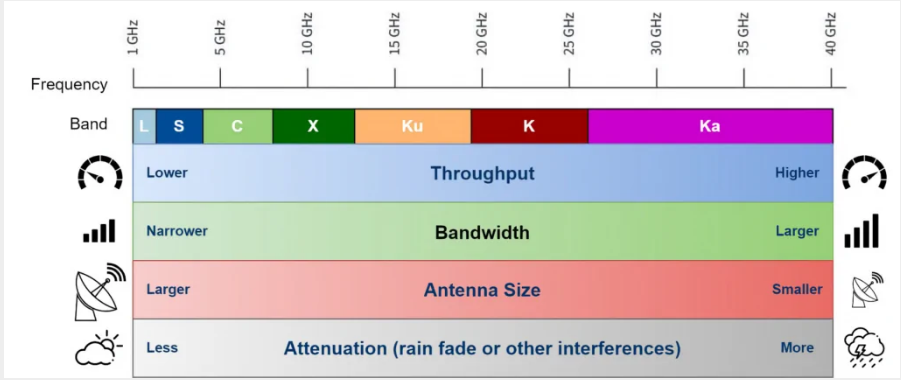
Common Uses in Satellite Systems
The UHF band’s resilience and relatively simple hardware requirements make it the go-to choice for several critical satellite applications where reliability trumps high data speed. Its primary role is often as a robust backup or primary link for narrowband, essential communications.
A dominant user of UHF satellite communications is the military and defense sector. Systems like the US Navy’s UFO (UHF Follow-On) and its replacement, the Mobile User Objective System (MUOS), provide global coverage. A single MUOS satellite, with a design life of 15 years, can support nearly 4,000 simultaneous users per satellite within its 5 MHz wide channels, offering data rates up to 384 kbps for prioritized tactical communications. This includes everything from voice commands to the transmission of sensor data and targeting coordinates with a latency often under 500 milliseconds.
| Application Sector | Primary Use Case | Typical Data Rate |
|---|---|---|
| Military & Defense | Tactical C2, Logistics | 2.4 kbps (voice) to 384 kbps |
| Government & Emergency | Disaster Relief, Paging | 64 kbps to 128 kbps |
| Scientific Research | Data Relay from Remote Sensors | 100 bps to 9.6 kbps |
| Asset Tracking (SCADA) | IoT, Pipeline Monitoring | 100 bps to 4.8 kbps |
Beyond the military, UHF is vital for government and emergency services. During natural disasters, when higher-frequency ground infrastructure may be destroyed, UHF satellite networks remain operational. Agencies deploy portable terminals with antennas as small as 0.5 meters in diameter that can be set up in under 15 minutes. These systems transmit crucial situational awareness data—text-based reports, email, and location tracking—at a steady 64 kbps, enabling effective coordination for first responders.
For scientific and environmental monitoring, UHF is the workhorse for Data Collection Systems (DCS). Thousands of autonomous platforms—like weather buoys in the ocean or seismic sensors in remote mountains—use UHF transmitters with a very low power consumption of just 2 to 10 Watts to relay small packets of data multiple times per day. A typical sensor might transmit a 200-byte packet containing temperature, pressure, and humidity readings every 6 hours, operating for 5-7 years on a single battery due to the extreme efficiency of the transmission cycle.
Key Advantages over Other Bands
The UHF band’s enduring value in satellite communications isn’t about being the fastest or highest capacity; it’s about providing unmatched reliability and operational simplicity in challenging conditions. Its advantages are most apparent when compared directly to higher-frequency bands like Ku-band (12-18 GHz) and Ka-band (26.5-40 GHz).
The single biggest advantage is superior signal penetration and resilience to environmental attenuation. A UHF signal at 300 MHz experiences less than 0.1 dB/km of attenuation due to rain in a heavy downpour (50 mm/hr). In stark contrast, a Ka-band signal at 30 GHz can suffer over 5 dB/km of loss in the same conditions, which can completely shut down a link. This translates to a 99.8% link availability for UHF in virtually all weather, compared to perhaps 97% for Ka-band in tropical regions, making it mission-critical for applications that cannot fail.
| Advantage | UHF Band (e.g., 300 MHz) | Ka-Band (e.g., 30 GHz) |
|---|---|---|
| Rain Fade (50 mm/hr rain) | < 0.1 dB/km attenuation | > 5 dB/km attenuation |
| Typical Link Availability | > 99.8% | ~97% in rainy climates |
| Foliage Penetration | Moderate loss (~3-6 dB) | Severe loss (> 15 dB), blocked |
| Terminal Antenna Size | 0.6m – 1.2m for high gain | 0.6m – 1.2m (for similar gain) |
This resilience extends to non-line-of-sight (NLOS) operations. UHF wavelengths, around 1 meter long, can diffract around obstacles and penetrate light foliage and building materials with a manageable signal loss of 3-6 dB. A Ka-band signal, with a wavelength of about 1 cm, is effectively blocked by the same obstacles, requiring a perfectly clear line-of-sight. This is why a UHF terminal can often maintain a link under a forest canopy or in an urban canyon, where a Ka-band terminal would drop completely.
From a cost and power perspective, UHF systems offer significant benefits. The components—oscillators, amplifiers, and receivers—for frequencies under 3 GHz are less expensive and more power-efficient. A UHF power amplifier can achieve 55-60% efficiency for a 50W output, while a Ka-band equivalent might struggle to reach 40% efficiency, generating more waste heat. This efficiency allows a man-portable UHF terminal to operate for 6-8 hours on a single battery charge while transmitting at 20-30W, a runtime that would be nearly halved for a Ka-band terminal doing the same job.
Typical UHF Antenna Designs
This omnidirectional antenna is famous for its cardioid-shaped radiation pattern, which provides a wide beamwidth of 120-140 degrees and a nominal gain of 2 to 4 dBi. Its key advantage is that it requires no physical pointing; you just mount it vertically and it provides a near-hemispherical view of the sky, making it perfect for applications on moving platforms like ships or aircraft. A typical commercial QHA is compact, measuring around 30 cm in height and 15 cm in diameter, and weighs under 2 kg.
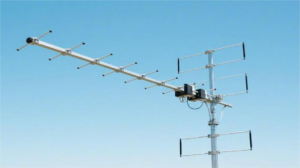
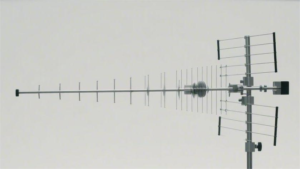
For fixed ground stations or applications requiring higher data rates, directional antennas are used. The crossed Yagi-Uda array is a popular choice. A typical Yagi for UHF satcom might have 8 to 12 elements, a boom length of 1.2 to 2 meters, and provide a gain of 9 to 12 dBi. Its beamwidth is narrower, around 30-40 degrees, which requires rough pointing toward the satellite but is far more forgiving than a Ka-band dish. The entire antenna assembly is lightweight, often under 5 kg, and can be mounted on a simple motorized azimuth rotor for tracking.
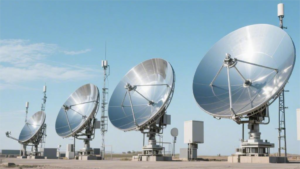
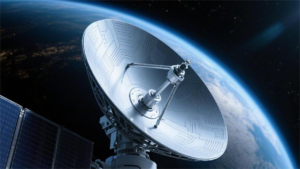
The most recognizable high-gain antenna is the parabolic reflector, or dish. However, at UHF frequencies, these dishes are much smaller and more manageable than their microwave counterparts. A standard 1.2-meter diameter parabolic dish with a helix feed can achieve a gain of approximately 18 dBi. The 3 dB beamwidth of this dish is about 15 degrees, which requires initial pointing but is still broad enough to tolerate minor platform movement or pointing errors of ±5 degrees without a significant signal drop. These dishes are often made from molded mesh or perforated aluminum to reduce weight and wind load, with a total weight of 15-20 kg.
- QHA Efficiency: A well-designed quadrifilar helix achieves 85-90% radiation efficiency.
- Yagi Cost: A commercial 12-element UHF Yagi antenna costs between $400 and $900, making it a low-cost entry point for fixed stations.
- Dish Performance: A 1.2m dish provides a 12 dB improvement in signal-to-noise ratio compared to a 4 dBi QHA, directly enabling higher data rates or more reliable links in noisy environments.
- Deployment Time: A trained technician can deploy and manually point a 1.2m dish to a geostationary satellite in under 10 minutes using a handheld spectrum analyzer.
- Power Handling: Standard coaxial cables like LMR-400 used with these antennas have an attenuation of less than 0.5 dB per 10 meters at 2 GHz, ensuring most of the transmitter’s 50-100W power reaches the antenna.
The material choice is also a key differentiator. While QHAs are often fully encapsulated in fiberglass for environmental protection, Yagis and dishes use 6061 aluminum for elements and structure, providing a lifespan exceeding 15 years with minimal maintenance. The design choice ultimately hinges on the trade-off between the operational need for mobility and the technical requirement for link budget.
Limitations and Signal Challenges
The entire usable UHF satellite allocation is only about 400 MHz wide, from around 300 MHz to 3 GHz, but this is further subdivided among countless services. In practice, a single satellite transponder channel is typically allocated a mere 5 MHz of bandwidth. This physical constraint directly caps the maximum achievable data rate. Using efficient modulation like BPSK or QPSK, a 5 MHz channel can support a raw data throughput of roughly 5-7 Mbps.
After accounting for forward error correction (FEC) overhead, which can consume 25-35% of the bitrate, the net usable data rate for a user drops to around 3.2 Mbps. When this capacity is shared across hundreds or even thousands of users in a network, individual data rates plummet to 19.2 kbps for legacy voice channels or 64-128 kbps for dedicated data links. This makes UHF completely impractical for modern high-bandwidth applications like video conferencing, which requires a minimum of 384 kbps, or streaming, which demands 1.5 Mbps or more.
This scarcity creates an intense congestion problem, especially in the 240-270 MHz military band. With a limited number of channels available, the probability of interference in a contested environment is high. Signal-to-noise ratios (SNR) can degrade by 3-6 dB due to co-channel interference, which can slice the effective data throughput in half. Furthermore, the relatively long wavelength of 1 meter makes the antennas susceptible to man-made noise from industrial equipment and urban environments. This raises the noise floor, and a 3 dB increase in noise requires a equivalent doubling of transmitter power at the terminal—from 20W to 40W—just to maintain the same link margin, drastically reducing portable terminal battery life from 8 hours to just 4 hours.
While UHF famously ignores rain, it is highly vulnerable to ionospheric effects, particularly Faraday rotation and scintillation. During periods of high solar activity, which follows an 11-year cycle, signal polarization can rotate by 10-15 degrees, causing a loss in signal alignment that can lead to 4-8 dB of fading at mid-latitudes. Severe scintillation near the equatorial region during local nighttime hours (20:00 to 24:00) can cause rapid signal fluctuations of 10 dB or more over a period of several minutes, resulting in burst errors and dropped links.
Comparing UHF with SHF Bands
Choosing between UHF and SHF (Super High Frequency, 3-30 GHz) for a satellite link isn’t about finding a superior technology; it’s about selecting the right tool for a specific job. The core trade-off is raw bandwidth and data throughput against robustness and operational simplicity. An SHF system, operating in the common Ku-band (12-18 GHz) or Ka-band (26.5-40 GHz), offers orders of magnitude more capacity. A standard Ku-band transponder has a 36 MHz bandwidth, over 7 times wider than a typical UHF 5 MHz channel. This allows a single Ku-band transponder to support a net data rate of 40-50 Mbps using modern modulation (e.g., 8PSK, 16APSK), enough for multiple high-definition video streams. In contrast, that entire UHF channel struggles to deliver a reliable 64 kbps data link after accounting for multiple access and coding overhead.
This bandwidth advantage comes at the cost of signal fragility. An SHF signal’s short wavelength of 2.5 cm at 12 GHz makes it highly susceptible to atmospheric absorption. A 15 mm/hr rain shower can cause 3-5 dB of attenuation on a Ku-band link, enough to trigger a modem to drop its modulation coding scheme to a more robust but slower mode. A 50 mm/hr downpour common in tropical regions can induce a 20 dB loss, completely obliterating the Ka-band link for minutes at a time. UHF signals, with their 1-meter wavelength, experience less than 0.1 dB of loss in the same storm, maintaining a 99.8% link availability year-round compared to Ka-band’s 96-97% in a rainy climate.
| Parameter | UHF Band (e.g., 300 MHz – 3 GHz) | SHF Band (e.g., Ku-band, 12-18 GHz) |
|---|---|---|
| Typical Transponder Bandwidth | 5 MHz | 36 MHz / 54 MHz |
| Net Data Rate per Transponder | ~3.2 Mbps | 40 – 120 Mbps |
| Rain Attenuation (50 mm/hr rain) | < 0.1 dB/km | ~20 dB total loss |
| Typical Link Availability | > 99.8% | ~97% |
| Terminal Antenna Size for 30 dBi Gain | 2.5 – 3.0 meters | 0.9 – 1.2 meters |
| Pointing Accuracy Requirement | ±5° (~0.5 dB loss) | ±0.2° (~3 dB loss) |
| Terminal Power Consumption (50W Tx) | ~180 Watts (PA + modem) | ~220 Watts (PA + modem) |
The physical hardware also reveals a stark contrast. To achieve a high gain of 30 dBi, a UHF system requires a large and cumbersome 2.5 to 3.0 meter parabolic dish. The same 30 dBi gain at Ku-band (14 GHz) can be achieved with a much more portable 0.9 meter dish.
However, this smaller size comes with a massive drawback: pointing precision. The UHF dish’s beamwidth is a forgiving ~8 degrees, meaning a pointing error of 5 degrees only introduces a minor 0.5 dB signal loss. The Ku-band dish’s beamwidth is a razor-thin ~1.8 degrees; a mispointing of just 0.2 degrees will cause a 3 dB loss, cutting the received signal power in half and requiring a sophisticated auto-pointing system for mobile use. While SHF terminal electronics are more complex, the overall cost for a commercial 1m Ku-band VSAT station (~$15,000) is in the same ballpark as a robust UHF manpack terminal, but for entirely different performance profiles. UHF buys unwavering reliability for narrowband critical comms; SHF purchases high-speed data with a weather dependency.