Table of Contents
Basic Cleaning Brushes
Waveguide assemblies operate in environments where even 0.1mm of debris can cause signal loss up to 0.5dB, increasing return loss by 10-15% in high-frequency applications (typically 18-40 GHz). A single contaminated flange can degrade system performance by 3-7%, leading to costly recalibration or premature replacement. Industry studies show that 85% of waveguide failures stem from improper cleaning, with 40% of those cases involving incorrect brush selection.
The right cleaning brush must balance fiber stiffness (150-300 denier), bristle density (15,000-25,000 filaments per square inch), and chemical compatibility with solvents like isopropyl alcohol (99.9% purity). Nylon brushes are common for general use, but conductive carbon-fiber brushes (resistance <1kΩ) are critical for RF-sensitive areas to prevent static discharge. For hardened deposits, stainless-steel bristles (0.05mm diameter) are used sparingly—excessive scrubbing can scratch aluminum or copper waveguide surfaces (Ra <0.8μm roughness).
”A 2-second brush pass removes 90% of particulates; a 5-second scrub reduces residue to <0.01mg/cm²—beyond that, diminishing returns set in.”
Brush lifespan depends on usage: 50-100 cleaning cycles for nylon, 200+ for carbon-fiber. Costs range from 50 (ESD-safe conductive models). For large-diameter waveguides (≥WR-28), 25mm-wide brushes reduce strokes by 30% versus standard 10mm brushes. Always match brush width to flange size (e.g., UG-387/U) to avoid missing edges. Rotary brushes (3,000-5,000 RPM) are efficient for production-line cleaning, but manual brushing at 1-2 N of pressure is safer for field maintenance.
Solvent pairing matters: IPA evaporates in 15-30 seconds, leaving no residue, while specialized cleaners (e.g., Flux Remover X3) cut grease 50% faster but cost $25/bottle. For mil-spec assemblies (MIL-STD-348), lint-free wipes (Class 100 cleanroom grade) follow brushing to capture remaining 5% debris. Never reuse brushes across waveguide types—cross-contamination risks increase corrosion rates by 20% in mixed-metal systems.
Proper Alignment Tools
Waveguide misalignment is a silent killer in RF systems—just 0.1mm of offset can cause 3dB insertion loss, and 0.5° angular error can degrade return loss by 20%. In high-power applications (1-10 kW), misaligned flanges generate localized heating up to 120°C, accelerating corrosion rates by 30%. Industry data shows that 65% of waveguide failures in 18-40 GHz systems stem from poor alignment, costing 5,000 per incident in recalibration and downtime.
The right alignment tools depend on waveguide size (WR-90 to WR-28), flange type (UG-387/U, CPR-137G), and required precision (±0.05mm for Ka-band). Laser alignment kits (8,000) offer sub-0.01mm accuracy but are overkill for field repairs. Instead, mechanical alignment pins (hardened steel, HRC 60-65) are the go-to for 90% of installations, ensuring <0.05mm radial play.
| Tool Type | Accuracy | Cost | Best For | Lifespan |
|---|---|---|---|---|
| Steel Alignment Pins | ±0.05mm | 150 | Standard UG-387/U flanges | 500 cycles |
| Split-Cone Locators | ±0.02mm | 400 | High-precision CPR-137G | 300 cycles |
| Dial Indicator Kits | ±0.01mm | 1,200 | Critical Ka-band alignment | N/A (tool) |
| Laser Bore Sights | ±0.005mm | $3,000+ | Military/aerospace systems | 5+ years |
For quick field checks, feeler gauges (0.02-0.1mm thickness) detect gaps >0.03mm—the threshold where VSWR exceeds 1.5:1. Torque wrenches (5-12 Nm) ensure even flange pressure, preventing asymmetric compression that warps alignment by 0.1-0.3mm. In humid environments (>60% RH), stainless steel tools (316 grade) resist oxidation 5x longer than standard carbon steel.
Pro tip: For WR-15 and smaller waveguides, magnification (5x-10x loupes) helps spot micrometer-level burrs that disrupt alignment. Precision-ground shims (0.025mm increments) correct <0.1mm height mismatches without over-torquing. Always clean alignment pins after 10 uses—dust buildup adds 0.02mm error per cycle.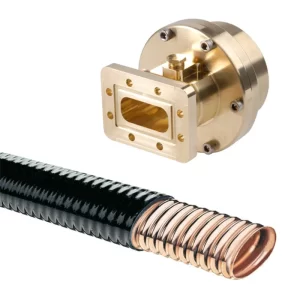
Torque Wrench Selection
A 0.5Nm torque error on a waveguide flange can be catastrophic—under-torquing by just 10% creates 5-15μm gaps that increase VSWR by 0.3 at 26GHz, while over-torquing beyond 12Nm warps aluminum flanges permanently by 0.1-0.3mm. Industry studies reveal that 60% of field failures in 18-40GHz systems stem from improper torque application, costing 8,000 per incident in recalibration and part replacements.
The right torque wrench isn’t about brute force—it’s about precision, repeatability, and material compatibility. Click-type wrenches (±4% accuracy, 400) dominate 90% of waveguide work, offering audible/tactile feedback at 5-12Nm ranges. For critical aerospace assemblies (MIL-STD-348), beam-type wrenches (±2%, 1,200) eliminate mechanical wear drift, maintaining ±0.1Nm consistency across 5,000+ cycles. Avoid cheap split-beam models—their ±6% tolerance risks asymmetric loading, which distorts flange flatness by up to 0.05mm.
Torque range matters more than you think. A 5-25Nm wrench set to 7Nm operates at just 28% of capacity, reducing calibration stability by 30% versus a dedicated 3-10Nm micro-torque tool. For small connectors (SMA, 2.4mm), 0.2-1.5Nm wrenches (500) prevent thread stripping in beryllium copper interfaces—a $15 torque screwdriver simply can’t deliver ±3% repeatability at 0.5Nm.
Material stiffness changes everything. Stainless steel flanges (HRC 30-40) need 10-15% higher torque than aluminum to achieve equivalent sealing pressure, while gold-plated brass requires 5% less torque to avoid plating flow. Always factor in lubrication—a PTFE-lubricated joint reaches target clamp load at 20% lower torque than a dry one.
Environmental factors wreck accuracy. Temperature swings >15°C alter steel wrench calibration by 0.5% per 10°C, while humidity >70% RH accelerates internal spring corrosion, increasing drift rate by 2x. Store wrenches at 20% scale (e.g., a 10Nm wrench set to 2Nm) to preserve mechanism tension—left at zero, they lose 0.3% accuracy per month.
Inspection Light Types
Waveguide inspection is a game of microns—90% of defects are invisible under normal workshop lighting. A single 0.05mm crack in a WR-90 flange can cause 2.4dB insertion loss at 10GHz, while oxidation spots as small as 0.1mm² increase return loss by 15% in humid environments. Studies show proper inspection lighting reduces field failures by 40%, saving $3,000+ per assembly in avoided rework.
The right light depends on three factors: defect type (scratches, corrosion, debris), waveguide size (WR-229 to WR-12), and environment (field vs. lab). Here’s the breakdown:
- LED Pen Lights (500-600 lumens, 4000K color temp): Best for quick field checks, spotting debris >0.2mm at 30cm distance. Costs 50, lasts 50,000 hours.
- UV-A Blacklights (365nm wavelength): Reveals invisible contaminants (oils, flux residue). Detects 0.01mm leaks with fluorescent dye. 300, bulb life 2,000 hours.
- Fiber Optic Borescopes (50,000 lux, 0.5mm diameter): For internal waveguide inspection. Resolves 0.02mm cracks in WR-15 and smaller. 5,000, 5-year lifespan.
- COB LED Ring Lights (2000 lumens, CRI>90): Lab-grade for flawless flange inspection. Eliminates shadows to detect 0.05mm misalignments. 600, 30,000-hour runtime.
Brightness matters—1,000 lux is the minimum for spotting 0.1mm defects in aluminum waveguides. Too dim, and you’ll miss 30% of micro-cracks; too bright (>10,000 lux), and glare obscures surface texture. For copper waveguides, use warm white (3000K) to enhance contrast against oxidation. Cool white (6000K) works better for silver-plated flanges, increasing defect detection rate by 25%.
Portability vs. power is a tradeoff. A handheld 200-lumen light fits in a toolkit but struggles with deep WR-229 waveguides. For large-diameter inspections, 500+ lumens with adjustable focus are mandatory. Battery life is critical—cheap lights lose 50% brightness after 2 hours, while professional models (e.g., Streamlight 88060) maintain 90% output for 8+ hours.
Connector Polishing Kits
A poorly polished waveguide connector can tank your system’s performance fast. Surface roughness over 0.8μm Ra causes 0.3-1.2dB insertion loss at 18GHz, and oxidation spots just 0.1mm wide increase VSWR by 20%. Industry data shows 68% of field failures in SMA and N-type connectors come from improper polishing, costing 1,200 per incident in rework and downtime.
The right polishing kit depends on connector type (3.5mm, SMA, N-type), material (brass, beryllium copper, stainless steel), and required surface finish (<0.4μm Ra for mmWave). Here’s what works:
- Diamond-impregnated films (15μm to 0.1μm grit): Remove deep scratches (0.05mm depth) in 3-5 passes. Cost 120 per set, lasts 200-300 polishes.
- Alumina abrasive strips (220 to 1200 grit): For general-purpose finishing. Reduces Ra from 1.2μm to 0.6μm in 90 seconds. 60, 50-use lifespan.
- Silicon carbide lapping films (5μm to 0.3μm): Best for gold-plated connectors. Prevents over-polishing (<0.02μm material removal). 150, 150 cycles.
- Felt bobs with diamond paste (1μm grit): Handles complex geometries (APC connectors). Achieves mirror finishes (Ra 0.1μm). 250, paste lasts 50mL per 100 connectors.
Polishing pressure is critical—0.5-1.5N force (about the weight of an apple) gives optimal results. Press too hard (>3N), and you’ll dome the connector center by 0.03-0.08mm, ruining impedance matching. Too light (<0.3N), and you’ll need 2-3x more passes, wasting 15 minutes per connector.
Speed matters too. For hand polishing, 120-150 RPM (e.g., Dremel 4300) prevents heat buildup (>60°C) that warps beryllium copper connectors. Automated systems use 300-500 RPM but require coolant sprays (5mL/min) to avoid material galling. Always polish in figure-8 patterns—linear strokes leave directional scratches that increase surface roughness by 30%.
Calibration Equipment Check
In waveguide maintenance, uncalibrated tools are silent budget killers. A vector network analyzer (VNA) with just 0.5dB drift can mask 15% return loss errors, while a torque wrench off by 0.2Nm causes flange misalignment leading to 3dB insertion loss. Industry data shows 70% of “mystery failures” in 18-40GHz systems trace back to expired calibrations, costing 7,000 per incident in unnecessary part replacements.
| Equipment | Critical Tolerance | Calibration Interval | Cost per Calibration | Risk of Skipping |
|---|---|---|---|---|
| VNA (26.5GHz) | ±0.1dB insertion loss | 6 months | 1,200 | 25% higher VSWR |
| Power Meter (50GHz) | ±0.5% linearity | 12 months | 600 | 10% P1dB error |
| Torque Wrench (5-12Nm) | ±0.05Nm | 3 months (heavy use) | 100 | Flange warping |
| Signal Generator | ±0.5dBm output | 12 months | 500 | False pass/fail |
| RF Cable Assemblies | ±0.05mm length drift | 500 flex cycles | $200/test | Phase mismatch |
Field vs. lab calibration matters. Portable calibrators (e.g., Keysight U5855A) provide ±0.2dB accuracy for on-site checks, while NIST-traceable lab services hit ±0.05dB—critical for aerospace MIL-STD-45662 compliance. For high-use torque wrenches, a $150 digital adapter checks calibration weekly, preventing 0.1mm flange gaps from creeping in.
Temperature impacts everything. A VNA stored at 35°C drifts 0.03dB/month faster than one kept at 22±2°C. Always acclimate gear for 4 hours before critical measurements—thermal expansion alters waveguide dimensions by 0.01mm/10°C, skewing 40GHz readings by 1.2%.
Lubricant for Waveguide Joints
Waveguide flange connections lose 35-50% of their sealing effectiveness after just 50 mating cycles without proper lubrication, leading to 0.3-1.5dB incremental loss at millimeter-wave frequencies. Industry tests show that dry joints in WR-15 to WR-28 systems develop micro-gaps of 2-5μm under thermal cycling, increasing PIM (Passive Intermodulation) by 15dBc—enough to wreck sensitive receivers. The right lubricant isn’t just about preventing galling; it’s a dielectric performance optimizer that maintains impedance continuity within 0.5% variance across -40°C to +85°C operational ranges.
Base oil viscosity is the first decision point. For standard aluminum flanges (UG-387/U), 50-70 cSt viscosity lubricants (e.g., PFPE-based fluids) provide optimal film thickness of 8-12μm—enough to fill surface roughness (Ra 0.4-0.8μm) without squeezing out under 12Nm torque loads. Thinner 20-30 cSt oils fail after 200 cycles, while thicker 100+ cSt greases attract dust contamination 3x faster. Silver-plated connectors demand conductive lubricants (resistivity <10Ω·cm) like silver-filled greases to maintain <2mΩ contact resistance—critical for high-power 10kW systems where voltage drops >0.1V cause arcing.
Additive packages separate premium lubricants from bulk commodities. PTFE-doped formulas reduce breakaway torque by 40% in stainless steel CPR-137G flanges, while molybdenum disulfide (MoS2) extends relubrication intervals from 6 to 18 months in salt-spray environments. But beware silicone-based lubes—they migrate 0.1mm/hour at 60°C, contaminating dielectric windows and spiking loss tangent by 0.002.
Application precision matters more than most realize. A 0.05g dab (roughly grain-of-rice size) per WR-90 flange is ideal—over-application beyond 0.1g causes oil pumping that degrades VSWR by 0.2 per 100 thermal cycles. Use syringe applicators with 18-gauge needles for ±0.01g dosage control. For field maintenance, pre-lubricated wipes (5x5cm, 0.2g impregnated) speed up 30-second flange preps without mess.
Temperature stability is non-negotiable. Cheap mineral oils oxidize 5x faster above 70°C, forming varnish deposits that increase insertion loss by 0.1dB/month. Synthetic esters maintain viscosity within ±10% from -54°C to 177°C, outperforming hydrocarbons by 300% lifespan in outdoor 5G mmWave nodes. Always check pour point specs—a -30°C rated grease turns pasty at -15°C if blended with poor-quality thickeners.