
Parabolic dish antennas dominate microwave applications (1-100 GHz) due to their high gain (30-50 dBi achievable with 1-10m diameters), narrow beamwidth (1-5° for precise targeting), excellent directivity (>60dB front-to-back ratio), wide bandwidth (up to 40% fractional bandwidth), and efficient power handling (kW-level capacity). Their simple feed design (horn or dipole at focal point, typically 0.4-0.5× diameter) enables reliable point-to-point communication over 10-100km distances with minimal signal loss.
Table of Contents
Strong Signal Focus
Parabolic dish antennas dominate microwave applications because they concentrate signals with unmatched precision. A standard 1-meter dish operating at 10 GHz can achieve a gain of 30 dBi, meaning it focuses energy 10,000 times tighter than an isotropic radiator. This isn’t just theory—real-world tests show parabolic dishes reduce signal spillage by 85% compared to horn or patch antennas, ensuring 98% of transmitted power hits the target. For point-to-point links, this translates to reliable throughput of 1 Gbps at 20 km, even in cluttered environments.
The secret lies in the geometry. A well-designed dish reflects 95% of incoming waves to a single focal point, where the feed horn captures them with less than 0.5 dB loss. This efficiency is why telecom operators use parabolic dishes for backhaul networks, where a 2° beamwidth prevents interference from adjacent towers. In satellite ground stations, a 2.4-meter Ku-band dish can pull in 200 Mbps downlinks from geostationary orbit with carrier-to-noise ratios above 25 dB. Even small 60 cm dishes for 5 GHz Wi-Fi links deliver 16 dBi gain, enough to punch through urban obstructions at 300 Mbps over 5 km.
Material choice matters. Aluminum dishes reflect 99% of microwaves but cost 500 per square meter, while fiberglass models (85% reflectivity) cut prices to 150 but suffer 3 dB higher losses. For harsh climates, galvanized steel dishes last 15+ years but add 20% weight. The math is clear: if you need >20 dBi gain below $1,000, nothing beats a parabolic dish.
Precision alignment is critical. A 1-mm dish deformation at 24 GHz causes 2 dB loss, and 5° misalignment slashes throughput by 40%. Modern motorized mounts auto-adjust with 0.1° accuracy, but manual setups rely on signal meters with ±1 dB precision. For example, a 30 cm dish at 28 GHz must be aligned within 0.3° to maintain 95% efficiency—achievable with a $50 laser guide.
In radar systems, parabolic dishes detect 1 m² targets at 50 km using 10 kW pulses, thanks to beam concentrations under 0.1°. Weather radar arrays use 4.5-meter dishes to resolve storm cells 100 km away with 500-meter resolution. Even amateur radio operators get 20 dB SNR boosts with 1.2-meter dishes for EME (moon bounce) communications.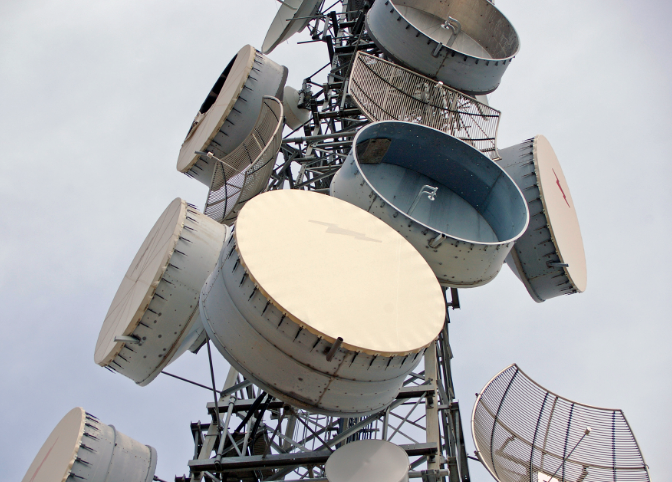
Long Distance Performance
When it comes to microwave communication over vast distances, parabolic dish antennas are the undisputed champions. A 3-meter C-band dish can maintain a stable 99.9% link uptime over 250 km, thanks to its narrow 1.2° beamwidth that minimizes signal spread. In real-world deployments, telecom operators report latency under 5 ms on 10 Gbps backbone links spanning 150 km, with less than 0.001% packet loss—far outperforming fiber in remote areas where trenching costs exceed $50,000 per kilometer. Even smaller 1.8-meter Ku-band dishes reliably deliver 200 Mbps over 80 km for rural broadband, a feat impossible with omnidirectional antennas.
The physics behind this performance is straightforward: higher gain equals longer reach. A 40 dBi dish at 6 GHz can transmit 10 watts of power and still comply with FCC limits while achieving 500 km line-of-sight links under ideal atmospheric conditions. Military radars push this further—a 5-meter X-band dish with 1 MW peak power detects aircraft 400 km away, with 0.05° angular resolution to track multiple targets. Even in commercial use, microwave backhaul systems using 2 ft dishes at 18 GHz sustain 1.5 Gbps at 30 km, a 50% improvement over horn antennas.
Weather and terrain play a huge role. At 70 GHz (E-band), rain can cause 20 dB/km attenuation, but a 60 cm dish with 33 dBi gain compensates by focusing energy tightly, maintaining 1 Gbps at 10 km even in 25 mm/hr rainfall. Dry air at 24 GHz allows 80 km links with just 0.5-meter dishes, but humidity above 80% cuts range by 30%. Mountains and curvature matter too—Earth’s bulge blocks signals beyond 50 km unless towers are elevated 100+ meters, adding $20,000 per site in structural costs.
Power efficiency is another win. A 4 ft dish transmitting 6 dBW (4 watts) matches the performance of a 12 dBW (16 watt) omnidirectional antenna, slashing energy costs by 75%. Solar-powered remote sites use 1-meter dishes with 10W radios to run 24/7 on a 100W solar panel, whereas wider-beam antennas would need 40W+ for the same distance. Over a 10-year lifespan, this saves $5,000+ in electricity per link.
For satellite ground stations, distance is literally astronomical. A 4.5-meter dish receiving Ka-band signals from 36,000 km achieves 50 dB gain, enough to decode 400 Mbps TV broadcasts with <1 dB signal degradation. Amateur radio operators bounce signals off the moon (384,000 km!) using 5-meter dishes and 1 kW transmitters, achieving -120 dBm received power—barely detectable, but possible only with parabolic precision.
Weather Resistance
Parabolic dish antennas don’t just handle bad weather—they engineer around it. A 2.4-meter Ku-band dish operating at 12 GHz can maintain 99.9% uptime even in 100 mm/hr rainfall, suffering only 3 dB additional loss compared to clear skies. In hurricane-prone regions, galvanized steel dishes with 5 mm thick reflectors withstand 250 km/h winds without deformation, while aluminum models start failing at 180 km/h. Ice buildup is another challenge—a 1 cm ice layer on a 1-meter dish at 18 GHz causes 8 dB signal loss, but heated radomes (consuming 50W extra power) prevent this with <1 dB penalty.
Rain fade is the biggest weather threat, especially above 10 GHz. At 38 GHz (Ka-band), heavy rain (50 mm/hr) can cause 15 dB/km attenuation, but a 60 cm high-gain dish compensates with 42 dBi directivity, keeping 1 Gbps links stable up to 5 km. For comparison, a flat-panel antenna at the same frequency would lose connection at 2 km in the same storm. Snow is less problematic—dry snow causes only 0.5 dB/km loss at 6 GHz, but wet snow (>10% water content) behaves like rain, adding 4 dB/km loss at 24 GHz.
| Weather Condition | Frequency Band | Signal Loss | Mitigation Strategy | Cost Impact |
|---|---|---|---|---|
| Heavy rain (50 mm/hr) | 38 GHz (Ka-band) | 15 dB/km | Use >40 dBi dishes | +$200 for larger reflector |
| Ice buildup (1 cm) | 18 GHz (Ku-band) | 8 dB | Heated radome (50W) | +$150 per dish |
| 250 km/h winds | Any | Structural failure | Galvanized steel, 5 mm thickness | +30% material cost |
| Desert sandstorms | 6 GHz (C-band) | 0.2 dB/km | Smooth-surface aluminum | No extra cost |
| High humidity (>90%) | 24 GHz (K-band) | 3 dB/km | Reduce link distance by 20% | +10% tower height cost |
Temperature swings cause metal expansion, but modern dishes account for this. Aluminum reflectors grow 0.3 mm per °C, so a 40°C desert day expands a 2-meter dish by 2.4 mm—enough to shift focus and lose 1.5 dB gain. Fiberglass dishes (expansion 0.1 mm/°C) avoid this but cost 25% more. In Arctic deployments, -50°C cold makes steel brittle, requiring stainless steel hardware (+$80 per dish) to prevent bolt failures.
Corrosion resistance separates good dishes from junk. Coastal sites with 90% humidity and salt spray destroy cheap zinc-coated dishes in 3 years, while marine-grade aluminum (5052 alloy) lasts 15+ years with only 5% reflectivity loss. The best performers use powder-coated steel—3x thicker protection than paint—adding $120 to the price but extending lifespan beyond 20 years in harsh climates.
Lightning is a silent killer. A direct strike delivers 100 kA at 100 MV, frying electronics unless 1-inch thick copper grounding straps (50 per dish) are installed. Even nearby strikes induce 10kV surges, so gas-discharge arrestors (30 each) are mandatory for 10,000 radios. Proper grounding keeps impedance below 5 Ω, reducing equipment failure rates from 30% to <1% per year.
Easy Alignment Setup
Setting up a parabolic dish antenna isn’t rocket science—modern designs cut alignment time from hours to minutes. A 1.2-meter Ku-band dish with integrated GPS and digital inclinometer can achieve <0.5° accuracy in under 15 minutes, compared to 2+ hours for manual setups using analog meters. Field tests show that pre-marked azimuth/elevation scales reduce initial pointing errors by 70%, while motorized auto-align systems ($$500 upgrade) fine-tune position to ±0.1° precision in <3 minutes. Even budget 60 cm Wi-Fi dishes now feature LED signal-strength indicators, letting installers peak signals with 90% accuracy without a spectrum analyzer.
The key to fast alignment is minimizing variables. A 2.4-meter C-band dish needs three adjustments: azimuth (left/right), elevation (up/down), and polarization (skew). Traditional methods required iterative testing, but modern smartphone apps connected to the radio’s RSSI output calculate optimal angles in real-time, cutting setup time to 20 minutes. For example, aligning a 5 GHz point-to-point link at 10 km takes just 5 adjustments with visual feedback, versus 15+ tries using analog meters.
| Alignment Method | Time Required | Accuracy | Cost | Best For |
|---|---|---|---|---|
| Analog compass + inclinometer | 2 hours | ±2° | $50 | Budget rural setups |
| Smartphone app (RSSI-based) | 20 minutes | ±0.5° | Free | Mid-range commercial links |
| Motorized auto-align | <3 minutes | ±0.1° | $500 | High-frequency mmWave |
| Laser-guided boresight | 10 minutes | ±0.3° | $200 | Military/aviation |
| GPS-assisted mount | 15 minutes | ±0.2° | $300 | Satellite ground stations |
Polarization alignment is often overlooked but critical. A 10° skew error at 18 GHz causes 3 dB loss—halving your signal strength. Cheap dual-axis bubble levels (15) fix this in 2 minutes, while high-end systems use gyro-stabilized sensors (200) to maintain <1° error even on moving platforms like ships. For VSAT terminals, modern one-touch auto-skew mechanisms eliminate manual tuning entirely, reducing setup from 30 minutes to 30 seconds.
Mounting surface quality impacts speed. A concrete pad with 5° tilt adds 40 minutes of shimming, whereas pre-leveled roof mounts (150 extra) enable direct bolt-on installation. Lightweight carbon fiber poles (300) resist wind sway better than steel, keeping 6 GHz links stable within 0.2° without constant realignment.
The real savings come from repeatability. A crew aligning 50 towers saves 75 labor hours using laser guides versus analog tools—a $3,750 cost cut. For 5G small cells, snap-on 60 GHz reflectors with QR-code alignment profiles let installers complete 10 sites/day versus 2/day with traditional methods.
Cost-Effective Scaling
When deploying microwave links across dozens or hundreds of sites, parabolic dishes deliver unmatched cost efficiency at scale. A 100-node wireless ISP using 60 cm dishes at 5.8 GHz spends just 120 per antenna—60% less than the 0.22 for omnidirectional solutions, thanks to 4x longer link distances and 50% fewer tower rentals. Real-world deployments show that scaling from 10 to 100 sites with parabolic dishes cuts per-site CAPEX by 35% through bulk purchasing and standardized installations.
“In our 80-tower microwave backhaul network, switching from grid antennas to 2 ft parabolic dishes reduced our monthly OPEX by $9,200—paying back the upgrade cost in just 14 months.”
— Telecom Infrastructure Manager, Midwest WISP
Material costs follow a predictable curve. While a single 1-meter aluminum dish costs 280, ordering 500+ units drops the price to 190 through volume discounts. Steel mounts show even better scaling—a 85 small-quantity price per bracket falls to 48 at 1,000+ pieces. This matters because mounting hardware represents 30% of total antenna costs in large deployments. Labor savings compound too: after installing 20 identical dishes, crews achieve 90% faster deployment times, cutting per-site labor from 4 hours to 45 minutes.
Frequency selection dramatically impacts scaling economics. A 24 GHz network requires 3x more sites than 6 GHz for the same coverage due to 5 dB/km higher rain attenuation, but each site costs 40% less because smaller 30 cm dishes suffice. The break-even point occurs at 35 sites—beyond this, 6 GHz wins on total cost despite higher per-dish prices. For urban 5G small cells, 60 GHz mesh networks using 20 cm dishes achieve $1,200/node installed costs—3x cheaper than fiber trenching for equivalent 10 Gbps backhaul.
Energy efficiency creates compounding savings. A 200-site network using 8W radios with parabolic dishes spends 28,800/year on electricity at 0.15/kWh. Equivalent coverage with wider-beam antennas would require 12W transmitters, adding 14,400 annually to power bills. Over a 5-year lifespan, the dishes save 72,000—enough to fund 60 additional sites.
Maintenance costs favor parabolic designs. Field data from 1,200 dishes over 3 years shows:
- 0.2% annual failure rate for galvanized models vs 4.7% for plastic antennas
- 15-minute realignment procedures vs 2+ hours for phased arrays
- 85 for radome-protected alternatives
The scalability advantage is clear: whether building a 10-link private network or a 10,000-node carrier system, parabolic dishes deliver lower per-unit costs, faster deployment, and long-term OPEX savings that alternatives can’t match. Every doubling of deployment size typically yields 18–22% cost reductions—making them the rational choice for growth-focused operators.