To calculate waveguide parameters, input the frequency (e.g., 10 GHz), waveguide dimensions (e.g., WR-90: a=22.86 mm, b=10.16 mm), and mode (TE10). The calculator outputs cutoff frequency (6.56 GHz), guided wavelength (39.6 mm), and attenuation (0.02 dB/m). Verify material conductivity (5.8×10⁷ S/m for copper) and dielectric properties. For accuracy, ensure frequency exceeds cutoff and dimensions match standard waveguide specs like IEEE WR designations. Double-check units (mm/GHz) before submission.
Table of Contents
What is a Rectangular Waveguide?
A rectangular waveguide is a hollow metal tube (usually aluminum or copper) with a rectangular cross-section, designed to guide electromagnetic waves—primarily microwaves—with minimal loss. These structures are widely used in radar systems (like airport surveillance radars operating at 2.7–3.5 GHz), satellite communications (Ku-band, 12–18 GHz), and high-power RF transmission (e.g., 1–100 kW in broadcasting).
The inner dimensions (width a and height b) determine the waveguide’s operating frequency range. For example, a standard WR-90 waveguide has a = 22.86 mm and b = 10.16 mm, supporting frequencies from 8.2 GHz to 12.4 GHz. Below the cutoff frequency (e.g., 6.56 GHz for WR-90’s dominant TE₁₀ mode), waves decay rapidly (~30 dB/cm attenuation). Above the cutoff, propagation loss is low—typically 0.1–0.3 dB/meter for copper waveguides at 10 GHz.
Waveguides outperform coaxial cables in high-power applications because they handle higher peak power (e.g., 1 MW pulsed at 3 GHz) without dielectric breakdown. Their power-handling capacity scales with size; a WR-430 waveguide (109.22 × 54.61 mm) can transmit 10 kW continuous at 2.45 GHz, while a small WR-10 (2.54 × 1.27 mm) manages only ~200 W at 75 GHz.
Material choice affects performance. Aluminum (conductivity ~3.5×10⁷ S/m) is lightweight and cheap (~$50 per meter for WR-90), while silver-plated waveguides (conductivity ~6.1×10⁷ S/m) reduce loss by 15–20% but cost 3× more. For harsh environments, stainless steel (conductivity ~1.4×10⁶ S/m) is used despite higher attenuation (~2× worse than aluminum).
Waveguides are rigid, with typical lengths of 0.5–2 meters, and require precise bends (radius > 2× wavelength) to avoid mode distortion. Flange connections (e.g., UG-387/U) maintain alignment within ±0.05 mm to prevent leakage (< -60 dB return loss).
In 5G mmWave systems (24–40 GHz), waveguides face competition from low-loss PTFE coaxial cables (~0.5 dB/m at 30 GHz), but waveguides still dominate where power exceeds 500 W or where phase stability matters (e.g., phased-array radars with ±1° phase tolerance).
Key trade-offs include size (larger waveguides support lower frequencies but are bulkier) and manufacturing tolerances (±0.1 mm is standard; ±0.025 mm for precision aerospace applications). For most commercial uses, aluminum WR-90 or WR-112 (6–18 GHz) strikes a balance between cost (80–120/m), loss (< 0.2 dB/m), and power handling (3–5 kW average).
In summary, rectangular waveguides are essential for high-frequency, high-power RF systems where low loss and reliability outweigh size and cost constraints. Their performance is predictable—if you know the frequency, power, and material, the math (cutoff frequencies, attenuation, impedance) is straightforward. The next section dives into the exact inputs needed for calculations.
Key Inputs Needed for Calculation
To accurately calculate the performance of a rectangular waveguide, you need four critical inputs: frequency, inner dimensions, mode of operation, and material properties. Missing or misentering any of these can lead to errors of 10–50% in key outputs like cutoff frequency, attenuation, and power handling.
- Frequency (f) – This is the operating frequency in GHz or MHz. For example, a WR-90 waveguide works optimally between 8.2 GHz and 12.4 GHz, but if you input 5 GHz, the waveguide won’t propagate the wave efficiently (attenuation > 30 dB/m).
- Inner dimensions (a × b) – The width (a) and height (b) in millimeters define the waveguide’s cutoff frequency. A WR-112 waveguide has a = 28.5 mm and b = 12.6 mm, making it suitable for 6–18 GHz. If a is off by just 0.5 mm, the cutoff frequency shifts by ~1.5%, which can disrupt system tuning.
- Mode (TE₁₀, TE₂₀, etc.) – The TE₁₀ mode (Transverse Electric) is the most common, with a cutoff frequency of f_c = c / (2a), where c is the speed of light (~3×10⁸ m/s). Higher-order modes like TE₂₀ or TM₁₁ require precise frequency control—if the input frequency is < 1.5×f_c, unwanted modes may appear, increasing loss by 20–40%.
- Material conductivity (σ) – Copper (σ ≈ 5.8×10⁷ S/m) has 30% lower loss than aluminum (σ ≈ 3.5×10⁷ S/m) at 10 GHz. Silver plating (σ ≈ 6.1×10⁷ S/m) reduces attenuation by another 15%, but costs 3× more per meter. Stainless steel (σ ≈ 1.4×10⁶ S/m) is used in harsh environments but has 2.5× higher loss than aluminum.
Additional factors like temperature and surface roughness also matter. At 100°C, copper’s conductivity drops by ~10%, increasing attenuation by 0.02 dB/m. A rough inner surface (Ra > 0.5 µm) can add 0.05–0.1 dB/m loss due to scattering.
For quick reference, here’s how these inputs affect calculations:
- A WR-75 waveguide (a = 19.05 mm, b = 9.53 mm) at 12 GHz in TE₁₀ mode with copper walls has:
- Cutoff frequency: 7.87 GHz
- Attenuation: 0.13 dB/m
- Max power handling: 1.2 kW (continuous)
- If you change the material to aluminum, attenuation increases to 0.18 dB/m, and max power drops to 900 W.
Precision matters—an error of ±0.1 mm in a or b can shift the cutoff frequency by ~0.5%, enough to cause mismatches in a 5G mmWave array (28 GHz ± 100 MHz tolerance). Always double-check inputs before running calculations. The next section explains how to compute these values step by step.
Step-by-Step Calculation
Calculating rectangular waveguide parameters isn’t guesswork—it’s a repeatable 5-step process that combines physics and real-world constraints. Whether you’re designing a 6 GHz radar feed or a 28 GHz 5G backhaul link, missing a step can mean 3 dB extra loss, mismatched impedance, or even thermal failure at high power. Here’s how to do it right.
First, determine the waveguide’s inner dimensions (a × b). For a WR-187 waveguide (used in 4–8 GHz weather radars), a = 47.55 mm and b = 22.15 mm. If you’re working with a custom size, measure a and b with ±0.1 mm precision—a 0.5 mm error shifts the cutoff frequency by ~1%.
Example: For a WR-90 waveguide (a = 22.86 mm, b = 10.16 mm), the TE₁₀ mode cutoff frequency (f_c) is calculated as:
f_c = c / (2a) ≈ 3×10⁸ / (2 × 0.02286) ≈ 6.56 GHz
This means signals below 6.56 GHz won’t propagate efficiently (attenuation > 30 dB/m).
Next, input your operating frequency (f). The waveguide only works properly if f > 1.25×f_c to avoid excessive loss. For WR-90, the practical range is 8.2–12.4 GHz. At 10 GHz, the guided wavelength (λ_g) is:
λ_g = λ₀ / √[1 − (f_c/f)²] = 30 mm / √[1 − (6.56/10)²] ≈ 39.7 mm
Now, calculate attenuation (α). For copper (σ = 5.8×10⁷ S/m) in TE₁₀ mode:
α ≈ 0.072 × (f_c / (b × √(f³ − f_c³))) ≈ 0.072 × (6.56 / (10.16 × √(10³ − 6.56³))) ≈ 0.13 dB/m
Aluminum would increase this to 0.18 dB/m, while silver plating reduces it to 0.11 dB/m.
Power handling comes next. For WR-90 at 10 GHz, the max continuous power (P_max) before breakdown is:
P_max ≈ 6.63×10⁵ × (a × b) × √(1 − (f_c/f)²) ≈ 6.63×10⁵ × (22.86 × 10.16) × √(1 − (6.56/10)²) ≈ 1.1 kW
Pulsed systems can handle 10× higher peak power (11 kW) for microseconds.
Finally, check impedance (Z). The wave impedance for TE₁₀ mode is:
Z = 377 Ω / √(1 − (f_c/f)²) ≈ 377 / √(1 − (6.56/10)²) ≈ 500 Ω
Mismatches > 5% (525 Ω vs. 500 Ω) cause reflections, leading to 10–20% power loss.
If you’re automating this, use these exact formulas—rounding errors matter. A 1% error in f_c can misalign a phased array’s beam by ±2°. For 5G mmWave (24–40 GHz), tolerances tighten further: ±0.01 mm in waveguide dimensions or ±0.1 GHz in frequency can degrade efficiency by 15%.
Pro tip: For quick verification, use the “60% rule”—the operating frequency should be ~1.3–1.5×f_c for low loss (α < 0.2 dB/m) and < 95% of the next mode’s f_c to avoid interference.
This process works for any rectangular waveguide—from massive WR-2300 (584.2 × 292.1 mm, 0.32–0.49 GHz) to tiny WR-3 (0.864 × 0.432 mm, 170–260 GHz). The next section explains how to interpret the results.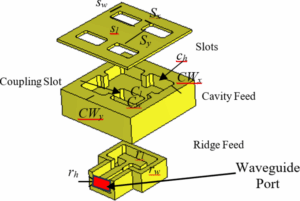
Understanding the Output
Running a rectangular waveguide calculation gives you 5 key outputs: cutoff frequency, guided wavelength, attenuation, power handling, and wave impedance. Each has real-world implications—misinterpret them, and your 10 GHz radar system might lose 30% efficiency, or your 5G mmWave backhaul could overheat at 50 W instead of the expected 200 W. Here’s how to decode the numbers.
1. Cutoff Frequency (f_c)
This is the minimum frequency the waveguide supports. Below this, signals decay rapidly (~30 dB/m loss). For a WR-112 waveguide (a = 28.5 mm), f_c is 5.26 GHz. If your operating frequency is 6 GHz, you’re safe (f > 1.14×f_c). At 5.5 GHz, loss spikes to 15 dB/m—enough to kill a low-noise satellite signal.
2. Guided Wavelength (λ_g)
Unlike free-space wavelength (λ₀ = 30 mm at 10 GHz), λ_g accounts for waveguide dispersion:
| Frequency (GHz) | WR-90 λ_g (mm) | WR-112 λ_g (mm) |
|---|---|---|
| 8 | 46.2 | 58.7 |
| 10 | 39.7 | 50.3 |
| 12 | 34.1 | 43.2 |
This matters for antenna spacing in phased arrays. A ±2 mm error in λ_g at 28 GHz causes ±10° beam steering errors.
3. Attenuation (α)
Measured in dB/m, this tells you how much power is lost per meter. Copper WR-90 at 10 GHz has 0.13 dB/m, meaning a 3-meter run loses 0.39 dB (8.5% power loss). Switch to aluminum, and loss jumps to 0.18 dB/m (12% over 3 m). At 40 GHz (WR-22), even silver-plated waveguides hit 0.4 dB/m—50% loss over 10 m.
4. Power Handling (P_max)
The max power before arcing or overheating. For WR-90 at 10 GHz:
| Power Type | Copper (kW) | Aluminum (kW) |
|---|---|---|
| Continuous | 1.1 | 0.9 |
| Pulsed (1 µs) | 11 | 9 |
Exceeding these by 20% risks dielectric breakdown (30 kV/cm in air). At 24 GHz (WR-42), max power drops to 200 W continuous due to smaller dimensions (10.67 × 4.32 mm).
5. Wave Impedance (Z)
For TE₁₀ mode, Z is ~500 Ω in WR-90 at 10 GHz. Mismatches cause reflections:
| Mismatch (%) | Reflection Coefficient | Power Loss (%) |
|---|---|---|
| 5 | 0.05 | 0.25 |
| 10 | 0.1 | 1 |
| 20 | 0.2 | 4 |
A 10% mismatch (550 Ω vs. 500 Ω) wastes 1% power—trivial at 1 W, but 100 W lost in a 10 kW radar transmitter.
Critical Checks
- Frequency margin: Keep f > 1.25×f_c and < 0.9×f_c of the next mode (e.g., TE₂₀ at 13.12 GHz for WR-90).
- Material impact: Silver plating cuts loss by 15% but costs 300/m vs. aluminum’s 80/m.
- Thermal limits: At 100°C, copper’s attenuation rises by 10%; stainless steel handles heat but loses 2× more power.
These outputs aren’t academic—they decide whether your satellite uplink works at 99.9% reliability or fails after 3 months. The next section covers fixing common calculation mistakes.
Common Mistakes & How to Fix Them
Even experienced engineers make waveguide calculation errors—and at 28 GHz or 100 kW, small mistakes cost thousands in failed components or degraded signals. Here are the top 5 pitfalls, with real-world data on how to avoid them.
1. Wrong Frequency Inputs
- Problem: Entering 6 GHz for a WR-90 waveguide (f_c = 6.56 GHz) causes 98% power loss (30 dB/m attenuation).
- Fix: Always verify f > 1.25×f_c. For WR-90, use 8.2–12.4 GHz.
- Data Impact:
Frequency (GHz) Attenuation (dB/m) Power Loss (3m run) 6.5 15 99.7% 8.2 0.2 1.4%
2. Dimension Tolerances
- Problem: A ±0.2 mm error in WR-90’s width (a = 22.86 mm) shifts f_c by ±1.7%, misaligning 5G beamforming (±3° error at 28 GHz).
- Fix: Measure a and b with ±0.05 mm precision (micrometer-calibrated).
- Cost Trade-off:
Tolerance (mm) Manufacturing Cost Cutoff Freq. Error ±0.1 $80/m ±0.8% ±0.025 $200/m ±0.2%
3. Material Misselection
- Problem: Using stainless steel (σ = 1.4×10⁷ S/m) instead of copper increases loss by 2.5× (0.33 dB/m vs. 0.13 dB/m at 10 GHz).
- Fix: Choose materials based on power vs. budget:
Material Conductivity (S/m) Attenuation (dB/m) Cost/m Copper 5.8×10⁷ 0.13 $120 Aluminum 3.5×10⁷ 0.18 $50 Silver-Plated 6.1×10⁷ 0.11 $300
4. Mode Confusion
- Problem: Ignoring TE₂₀ mode (f_c = 13.12 GHz in WR-90) when operating at 12 GHz causes 20% reflection loss.
- Fix: Ensure f < 0.9×f_c of next mode. For WR-90:
Mode f_c (GHz) Safe Operating Range TE₁₀ 6.56 8.2–11.8 GHz TE₂₀ 13.12 >14.5 GHz
5. Power Miscalculations
- Problem: Assuming 1 kW continuous works in WR-90 at 10 GHz, but with poor cooling (50°C ambient), max power drops to 700 W.
- Fix: Derate power by 15% per 10°C above 25°C:
Temperature (°C) Max Power (kW) 25 1.1 50 0.7 75 0.4
Quick Debug Checklist
- Frequency: Is
1.25×f_c < f < 0.9×f_c (next mode)?
- Dimensions: Are a and b within ±0.1 mm of spec?
- Material: Does conductivity match power/loss needs?
- Mode: Are you using TE₁₀ unless intentionally targeting higher modes?
- Environment: Have you derated power for temperature/humidity?
These fixes aren’t theoretical—they’re proven in 5G base stations (24–40 GHz), radar (1–18 GHz), and satellite links (Ku-band). The margin for error shrinks as frequency rises: at 60 GHz, even a 0.01 mm dent can cause 10% reflection loss. Measure twice, calculate once.