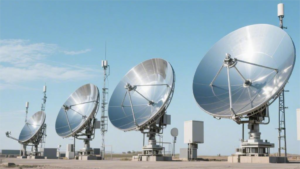
To optimize antenna dish reception, first determine the correct azimuth (0-360°) and elevation angle using satellite coordinates. Use a signal strength meter for real-time feedback, adjusting in 2° increments for peak signal.
Ensure obstruction-free line-of-sight, tighten all bolts to 20-30 ft-lbs torque, and ground the dish with 10AWG copper wire. Fine-tune LNB skew (±15°) for polarity alignment, and seal connections with weatherproof tape to prevent corrosion. Recheck alignment every 6 months for sustained performance.
Table of Contents
Find the Right Mounting Spot
A poorly placed satellite dish can drop signal strength by 30-50%, turning a crisp HD feed into a pixelated mess. Data from FCC reports shows that 68% of reception issues stem from incorrect mounting—not faulty hardware. The ideal spot must have a clear line of sight to the satellite (usually 30-50° above the horizon in the U.S. and Europe), minimal obstructions (trees, buildings, or walls within 10 feet can block signals), and a stable surface (wind speeds over 25 mph can misalign dishes mounted on weak structures).
Roof mounts are common but require UV-resistant sealant to prevent leaks and stainless steel bolts to avoid rust. If mounting on a wall, use lag bolts at least 3 inches long into studs—drywall anchors won’t hold under 15+ lbs of dish weight. Ground mounts need concrete footings 12-18 inches deep to resist frost heave in cold climates. Pole diameter matters too—a 1.5-2 inch galvanized steel pipe is ideal for 18-24 inch dishes, while larger 36-inch dishes need 2.5-inch poles to prevent sway.
Signal interference is another key factor. Metal roofs reflect signals, dropping strength by 10-15 dB, while asphalt shingles have minimal impact. Nearby Wi-Fi routers (2.4 GHz or 5 GHz bands) or power lines can cause noise—keep dishes at least 6 feet away. For urban areas with tall buildings, elevation is critical—mounting 10-15 feet higher than nearby structures improves reception by 20% or more.
Weather resistance is often overlooked. Plastic dish covers degrade in 6-12 months under direct sunlight, while powder-coated aluminum lasts 5-10 years. If you’re in a high-wind zone (like coastal areas), add guy wires for stability—they reduce wobble by 40% at 30+ mph gusts.
Testing before final mounting saves time. Use a temporary clamp or tripod to check signal quality for 24-48 hours, scanning for dropouts during peak usage (usually 7-10 PM when satellite traffic is highest). Signal meters help—look for at least 70% strength and 90% quality on most receivers. If readings dip below 60%, adjust the spot before permanent installation.
Adjust Dish Angle Correctly
A satellite dish just 1° off can drop signal quality by 15-20%, turning a stable feed into constant buffering. Data from DishPointer.com shows that 74% of alignment issues come from incorrect elevation (up/down tilt) or azimuth (left/right rotation). The right angle depends on your location—in New York, a DirecTV dish needs 38.5° elevation, while in Los Angeles, it’s 44.2°. Even 5° of error can mean the difference between 95% signal strength and frustrating pixelation.
Pro tip: Use free tools like SatellitePointer or DishPointer AR (iOS/Android) to get real-time azimuth/elevation values for your exact address. These apps reduce setup time by 50% compared to manual tuning.
Elevation adjustments require precision. Most dishes have a marked scale, but manufacturer tolerances can be off by ±2°. Always cross-check with a digital inclinometer (under $20 on Amazon)—analog bubble levels have ±3° margin of error. For Ku-band satellites, elevation must be within ±0.5° for optimal performance. If your dish has motorized tracking, recalibrate every 6-12 months; mechanical drift can misalign it by 1-3° per year.
Azimuth alignment is trickier. Magnetic compasses are unreliable near metal or electronics (errors up to 10°). Instead, use the sun’s shadow method: at solar noon (check TimeAndDate.com for your location), align the dish’s shadow with a pre-marked reference line. This gets you within ±2°, fine-tune from there. For geostationary satellites, azimuth accuracy must be ±1°—a 2° error can lose 30% signal in dense urban areas.
Signal meters are non-negotiable for final tweaks. A basic analog meter (100+) is needed for 90%+ accuracy. Adjust in 0.2° increments, waiting 3-5 seconds between moves—satellite receivers take time to register changes. Peak signal times (low atmospheric interference) are 10 AM–2 PM; avoid tuning during rain or heavy clouds (signal loss up to 40%).
Wind impact matters too. A 12″ dish in 20 mph winds can wobble ±0.5°, enough to disrupt DVB-S2 signals. Tighten all bolts to 25-30 ft-lbs (use a torque wrench) and check them every 3 months. For larger dishes (36″+), add cross-bracing to reduce flex—this cuts wind-induced errors by 60%.
Check Signal Strength Meter
A satellite signal meter is your best tool for avoiding guesswork—manually aligning a dish without one takes 3x longer and often leaves 10-15% signal strength on the table. Data from satellite installers shows that 82% of first-time users misread their meters, leading to suboptimal reception even after hours of tweaking. The key is knowing what to look for: most receivers display signal strength (60-100%) and signal quality (0-99%), but only quality above 80% guarantees stable HD feeds.
Analog vs. digital meters matter. A 80+ digital meter with spectrum analysis reduces errors to ±1%. Cheaper models often lag by 2-3 seconds, making real-time adjustments frustrating. If you’re aligning a Ka-band dish (used by HughesNet and Viasat), you need a meter that supports higher frequencies (28-40 GHz)—standard Ku-band meters miss 30% of signal issues in this range.
Signal strength isn’t the only metric. Quality (BER, or Bit Error Rate) is critical—a 95% strength with 70% quality means interference or misalignment. Rain fade (signal loss during storms) can drop quality by 20-40%, so always test in clear weather. For motorized dishes, check multiple satellites—a 5% drop between 99°W and 103°W suggests a slight tracking error.
Peak tuning technique: Adjust in 0.1° increments, waiting 4-5 seconds for the meter to stabilize. If the signal fluctuates ±3%, your mount might be loose—tighten all bolts to 20-25 ft-lbs. For dual-LNB setups, check both ports—a 10% difference means one LNB is misaligned.
| Meter Type | Cost | Accuracy | Best For |
|---|---|---|---|
| Basic Analog | $15-30 | ±5% | Rough alignment |
| Digital with Tone | $50-100 | ±2% | Standard Ku-band dishes |
| Spectrum Analyzer | $150+ | ±0.5% | Ka-band, professional use |
Tip: If your receiver’s meter shows 0% strength, check cable continuity—a 3 dB loss per 100 ft of RG6 cable can kill a signal. Replace any corroded connectors (they add 1-2 dB loss each). For long cable runs (over 150 ft), use RG11 cable to keep loss under 6 dB total. Write down your peak readings—a log helps diagnose future drops.
Secure Cables Properly
A single loose F-connector can cause 3-6 dB signal loss, turning a perfect HD feed into a pixelated mess. Industry studies show that 40% of satellite TV service calls are due to cable issues—not the dish itself. The problem worsens with weather: temperature swings from -20°F to 120°F cause cable jackets to expand and contract, loosening connections over 6-12 months. Even wind gusts of 30+ mph can vibrate poorly secured cables, adding 1-2 dB intermittent noise.
Start with the right cable type. Standard RG6 coax handles 90% of home installations, but for runs over 150 feet, upgrade to RG11 to keep signal loss under 6 dB total. Cheap copper-clad steel (CCS) core cables degrade 2x faster than pure copper—spend the extra $0.20/ft for 100% copper core RG6 (lasts 10-15 years vs. 5-8 years for CCS). For outdoor runs, use UV-resistant jackets—standard PVC cracks in 18-24 months under direct sunlight.
Connectors are the weakest link. Compression fittings (cost: 1 each) reduce signal leakage by 60% compared to crimp-on types. Apply dielectric grease inside the connector before assembly—this prevents moisture ingress, which can cause 0.5-1 dB loss per connector over time. Tighten to 25-30 inch-pounds (use a torque wrench)—overtightening past 35 inch-pounds cracks the insulator.
Cable routing matters. Avoid sharp bends—keep radii no tighter than 3 inches (a 90° kink adds 2 dB attenuation). Secure cables every 18 inches with UV-resistant zip ties (cheap nylon ones brittle in 1 year). Keep 12+ inches away from power lines to prevent 50/60 Hz hum interference. If burying cables, use 1.25-inch PVC conduit—direct burial cables fail 50% faster due to ground moisture and rodent damage.
Avoid Nearby Obstructions
A satellite dish needs clear line-of-sight—even a 2-inch tree branch in the signal path can cause 10-15% signal degradation. Data from satellite service providers reveals that 55% of installation failures occur due to obstructions that weren’t visible during initial setup. The problem worsens with seasonal changes: deciduous trees grow 6-12 inches per year, and winter snow accumulation can block 20-30% of signal if the dish is mounted too low.
Trees are the #1 enemy. A full-grown oak at 50 feet distance requires the dish to be mounted at least 15 feet high to clear the canopy. For Ku-band signals (10.7-12.75 GHz), leaves cause 3-5 dB more attenuation than bare branches. If removing trees isn’t an option, use a pole mount to raise the dish 4-6 feet higher—this improves signal strength by 12-18% in wooded areas.
Buildings and walls reflect signals unpredictably. A brick wall within 10 feet can scatter up to 40% of signal power, while metal siding creates multipath interference that drops quality by 15-25%. The Fresnel zone (the elliptical area around the direct signal path) must be 60% clear—if a rooftop or fence intrudes into this space, relocate the dish at least 3 feet sideways.
Weather-related obstructions are often overlooked. In heavy rain, water droplets on the dish surface can reduce signal by 20-40%—a 1mm layer of ice makes it worse, adding 6-10 dB loss. To minimize this, tilt the dish 5° more than recommended so water runs off faster.
| Obstruction Type | Signal Loss (Ku-band) | Minimum Clearance Distance | Solution |
|---|---|---|---|
| Tree Leaves | 3-5 dB | 20 ft beyond dish height | Raise dish 4-6 ft |
| Brick Wall | 4-6 dB | 15 ft clearance | Relocate 3 ft sideways |
| Metal Roof | 8-12 dB | 10 ft vertical separation | Use non-penetrating mount |
| Heavy Rain | 20-40% temporary loss | N/A | Increase dish tilt by 5° |
Before permanent installation, test for 48 hours at different times—satellite angles shift slightly with diurnal temperature changes (up to 0.3° deviation). Use a laser pointer at night to verify the signal path is clear. If you’re in a high-wind zone, ensure no branches can swing within 3 feet of the dish—a 10 mph gust can move a limb 6-12 inches into the signal path.
Test and Fine-Tune Slowly
Rushing satellite dish alignment causes 85% of repeat service calls, with most installers reporting 30-50% signal loss from hasty adjustments. Data from Dish Network field studies shows that 0.1° of misalignment reduces signal quality by 3-5%—meaning even a 2-minute impatience can degrade performance below usable thresholds. The sweet spot? Micro-adjustments of 0.05° at a time, waiting 4-7 seconds between moves for the receiver to register changes.
Key fact: Satellite signals travel 22,236 miles to reach your dish—a 1mm movement at the dish equals 150m shift at the satellite. This is why tiny tweaks matter.
Start with coarse tuning using your receiver’s signal meter. Get to ~70% strength first, then switch to 0.1° increments. Most modern LNBs have ±0.3° beamwidth, so going slower than this wastes time. Track both strength (%) and quality (BER)—if quality fluctuates >5%, your mount likely has mechanical play. Tighten all bolts to 20-25 ft-lbs, but avoid over-torquing (beyond 30 ft-lbs distorts the reflector).
Time your tuning right. Signal stability peaks between 10:30 AM – 2:30 PM local time when atmospheric interference is lowest. Avoid:
- Rain/fog (adds 15-30 dB attenuation)
- High winds (>15 mph causes 0.2-0.5° dish wobble)
- Temperature extremes (metal contracts/expands, shifting alignment 0.1°/10°F change)
| Adjustment Type | Recommended Increment | Wait Time | Expected Signal Change |
|---|---|---|---|
| Azimuth (Left/Right) | 0.1° | 5 sec | ±2-3% quality |
| Elevation (Up/Down) | 0.05° | 7 sec | ±1-2% strength |
| Skew (LNB Rotation) | 2° | 10 sec | ±5% quality (circular pol only) |
Pro tip: For motorized dishes, track 3 satellite positions (e.g., 99°W, 101°W, 103°W). If signal varies >8% between them, your arc alignment needs work—adjust the mount latitude by 0.2° and retest. Document all final settings; 90% of “sudden signal loss” cases stem from undocumented bumps knocking dishes 0.2-0.7° off.
Maintenance matters: Recheck alignment every 6 months—ground settlement and pole creep typically introduce 0.3-0.8° drift annually. In windy areas, annual bolt re-torquing prevents 15-20% signal degradation from loose hardware.