Electromagnetic waveguide theory underpins antenna design by shaping radiation patterns and optimizing feed structures. For example, rectangular waveguides—common in horn antennas—operate at 10 GHz using a 22.86mm height (WR-90 standard), supporting TE10 mode with a cutoff frequency of ~6.56 GHz. Impedance matching via waveguide-to-microstrip transitions reduces VSWR to <1.5, enhancing power transfer efficiency by 20-30% compared to unmatched designs.
Table of Contents
Basic Waveguide Concepts Explained
At 30GHz, a typical RG-405 semi-rigid cable loses ~0.5dB per meter—translate that to 11% power loss over just 2 meters. Waveguides? They slash that: a standard WR-90 rectangular waveguide (used for 8.2–12.4GHz) has a loss of ~0.03dB per meter at 10GHz, meaning 99.7% of the signal stays put over 2 meters.
The most common mode in rectangular waveguides (the workhorse for antennas) is the TE10 mode (Transverse Electric, 1 half-wave in the wider dimension). Why TE10? Because it’s the lowest-loss mode at most operating frequencies, and it avoids the “cutoff frequency” problem: if your signal’s frequency is below the waveguide’s cutoff, it won’t propagate at all. For a WR-90 waveguide (inner dimensions: 22.86mm wide × 10.16mm tall), the TE10 cutoff frequency is ~6.557GHz. Go below that, and your signal dies; go above, say 8GHz, and TE10 hums along with low loss.
To design an antenna that works with a waveguide, you need to match three things: the waveguide’s mode, the antenna’s input impedance, and the operating frequency. Mismatch causes reflections—power bounces back toward the transmitter instead of radiating. A VSWR (Voltage Standing Wave Ratio) of 1.0 means perfect matching; in practice, antennas aim for VSWR ≤1.5. But how do you measure this? With a vector network analyzer (VNA), which sends a test signal through the waveguide-antenna system and measures reflections. For example, a 28GHz horn antenna (common in 5G mmWave systems) paired with a WR-15 waveguide (a=3.66mm, b=1.83mm) might have a VSWR of 1.2 at 28GHz—translating to 98% power transfer efficiency. Not bad, but tweak the antenna’s flange dimensions by 0.1mm, and VSWR jumps to 1.5 (90% efficiency)—a 8% drop in radiated power.
| Parameter | Example (WR-90) | Impact on Antennas |
|---|---|---|
| Cutoff Frequency (f_c) | ~6.557GHz | Below f_c: No signal propagation |
| Operating Band | 8.2–12.4GHz | Antennas must tune within this range |
| TE10 Mode Loss @10GHz | ~0.03dB/m | 99.7% power retained over 2m length |
| Typical Flange Size | 22.86mm × 10.16mm | Must match antenna flange for low VSWR |
A waveguide feeding a horn antenna (a simple, broad-beam antenna) uses TE10 to launch a linearly polarized wave that spreads out smoothly. If a higher-order mode (like TE20, which has two half-waves in the wide dimension) creeps in, the radiation pattern distorts—think of it as adding ripples to a smooth water surface. For directional antennas (e.g., parabolic dishes fed by waveguides), even small mode distortions can reduce gain by 2–3dB (a 40–60% drop in focused power).
Converting Waves to Radiation
For instance, a poorly designed transition from a WR-75 waveguide (operating at 10–15 GHz) to a radiating element can result in reflections as high as 20% (VSWR ≈1.5), effectively wasting one-fifth of your output power as heat within the system. The goal is to engineer a smooth impedance transformation, matching the waveguide’s ~500-ohm characteristic impedance for the TE10 mode to the 377-ohm impedance of free space, minimizing this loss to under 2% (VSWR <1.1).
The most straightforward and widespread example of this conversion is the pyramidal horn antenna. Think of it as a flared waveguide section that acts as an impedance transformer and a directional radiator. The flare does two critical jobs: it gradually increases the waveguide’s cross-section to match the impedance of free space, and it forms the radiated wavefront. The dimensions of this flare are not arbitrary; they are calculated based on the desired gain and operating frequency. A horn for the 18–26.5 GHz band (using a WR-42 waveguide with internal dimensions of 10.67mm x 4.32mm) might have a 35mm aperture length (L) and a 22mm aperture width (W). This specific geometry provides a gain of approximately 20 dBi at 24 GHz, focusing the energy into a beam with a 15-degree half-power beamwidth. If the flare angle is too steep (e.g., exceeding 25 degrees), the phase error across the aperture increases, leading to a 2–3 dB drop in gain and a distorted radiation pattern with higher sidelobes.
A key design trade-off is between physical size and performance. A longer horn (e.g., 100mm vs. 50mm at 10 GHz) yields a better impedance match and a more uniform phase front, boosting gain by up to 1.5 dB and improving return loss from -15 dB to -25 dB. However, this adds 50mm to the assembly, which is often prohibitive in space-constrained applications like satellite comms or radar arrays.
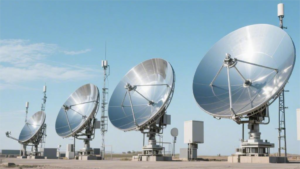
Beyond horns, the open-ended waveguide is itself a simple radiator, though its directivity is low (~8 dBi). It’s often used as a feed for a parabolic reflector. The critical parameter here is the placement of the waveguide opening relative to the reflector’s focal point. A 2mm axial misalignment in a 2.4-meter C-band satellite dish (f/D ratio of 0.35) can degrade the antenna’s overall efficiency by 8%, from 65% to 57%, scattering precious signal into the surrounding environment. To prevent this, a choke ring or a corrugated flange is often added around the waveguide opening. These features suppress currents from flowing on the outer waveguide wall, which can distort the radiation pattern. A well-designed corrugated flange can reduce unwanted sidelobes by 10–15 dB, ensuring a cleaner, more directed beam.
Waveguide Horn Antenna Design
For instance, a typical X-band pyramidal horn operating from 8 GHz to 12 GHz, built for a standard WR-90 waveguide (22.86 mm × 10.16 mm), requires precise flare geometry to achieve a gain of 20 dBi with a half-power beamwidth of 15 degrees. Miscalculating the flare length by just 5 mm can introduce a phase error of 15 degrees at the aperture, reducing gain by up to 1.2 dB and raising sidelobes by 3 dB—effectively scattering 25% of the radiated power in unwanted directions. The flare angles in both E-plane (usually 20–30 degrees) and H-plane (15–25 degrees) must be optimized to avoid abrupt wave impedance changes; a 25-degree E-plane flare angle typically yields a return loss better than -20 dB (VSWR <1.2) across 85% of the band.
For a gain target of 25 dBi at 18 GHz, the horn aperture must be approximately 95 mm × 72 mm, assuming an efficiency of 65%. This efficiency loss comes from multiple factors: about 5% is due to ohmic losses in the aluminum walls (surface roughness ~2 µm increases loss by 0.3 dB/m), while another 10–15% is spilled over around the edges because of imperfect phase correlation. To boost efficiency to 80%, many designers add corrugations inside the flare section.
A dimensional tolerance of ±0.1 mm is acceptable for frequencies below 15 GHz, but at millimeter-wave bands like 60 GHz, this tightens to ±0.05 mm. A 0.2 mm deviation in the throat region (where the waveguide transitions to the flare) can shift the center frequency by 500 MHz and degrade return loss from -25 dB to -12 dB, making the antenna unusable in a high-capacity 5G link requiring 256-QAM modulation.
For mass-produced horns, extruded aluminum keeps unit cost down to 40–60, but for low-noise radio astronomy applications (e.g., receiving signals at 12 GHz with a noise temperature under 50 K), electroformed copper with a 5µm silver plating is used, pushing cost to $300 per unit but improving conductivity by 8% and reducing thermal noise contribution by 0.7 K. The final step is always testing with a vector network analyzer; a well-designed horn should exhibit a VSWR below 1.15:1 across at least a 15% fractional bandwidth (e.g., 13.5–15.5 GHz for a Ku-band design), ensuring 99% power transmission with minimal reflection.
Feeding Antennas with Waveguides
For a common X-band radar system operating at 9.5 GHz, a mere 0.1 mm misalignment between a WR-90 waveguide flange and the antenna’s input port can increase the Voltage Standing Wave Ratio (VSWR) from an ideal 1.05 to 1.35, causing a 4% power loss and generating enough heat to raise the local junction temperature by 15°C. This loss directly reduces radar range by 2.5%.
- Standard UG-style flanges for WR-90 waveguides have a specified ±0.05 mm tolerance on the mating surface and pin alignment. A deviation of 0.07 mm can increase the insertion loss by 0.2 dB at 10 GHz, which equates to a 4.5% drop in radiated power.
- For high-power applications (e.g., 50 kW radar pulses), the flange bolts must be torqued to a precise 12 N·m. Under-torquing by 20% to 9.6 N·m can create microscopic gaps, leading to arcing that can burn out a $5,000 transmitter tube in under 100 hours of operation.
- Flexible waveguide sections, often used for alignment compensation, have a shorter lifespan of roughly 5,000 flex cycles at 18 GHz before their loss increases by 50% from the initial 0.1 dB per 30 cm section.
A common practice is to use a tapered waveguide section to transform the waveguide’s impedance to match the antenna’s feed point. For a parabolic dish antenna, the waveguide feed must be positioned at the precise focal point, which is typically calculated to within ±0.5% of the dish’s diameter. A 15-meter C-band satellite antenna with a 1.8-meter focal length suffers a 10% gain loss if the feed is misplaced by just 18 mm.
Controlling Radiation Patterns
Whether focusing a tight beam for a long-range 60 GHz point-to-point link requiring ±1.5° accuracy or creating a specific null to reject an interfering signal 20 dB below the main lobe, pattern control dictates success. A 2 dB increase in sidelobe levels in a 4000-element 5G base station array can raise interference by 60%, reducing sector capacity by 15% and potentially violating FCC emissions masks. Conversely, improving main beam gain by just 1 dB through precise pattern synthesis can extend a 28 GHz link’s range by 12% or reduce required transmitter power by 20%, saving $15,000 in amplifier costs per cell site.
- Aperture Size and Shape: The most basic determinant. A 2-meter diameter parabolic dish operating at 12 GHz has a theoretical half-power beamwidth (HPBW) of approximately 1.8 degrees and a gain of 44 dBi. Reducing the diameter to 1.5 meters widens the HPBW to 2.4 degrees and drops the gain by 3 dB, effectively halving the effective radiated power.
- Amplitude Tapering: Uniform illumination of the aperture yields the highest gain but also the highest sidelobes (approx. -13 dB). Applying a -10 dB Taylor taper (amplitude is strongest at the center and reduced at the edges) suppresses sidelobes to -25 dB but sacrifices 1.2 dB in gain and increases the HPBW by 20%. This is a critical trade-off for radar systems where low sidelobes (-30 dB or better) are needed to avoid detecting clutter.
- Phase Control (Beam Steering): In phased arrays, a 1-degree phase error across the array can distort the beam pointing angle by 0.5 degrees and raise sidelobes by 2 dB. For an S-band (3.5 GHz) radar with 1000 elements, a time delay error equivalent to 5 ps per element can steer the main beam 0.7 degrees off-target, creating a 200-meter position error at a 20 km range.
A corrugated horn designed for the 18-26.5 GHz band can produce a symmetric pattern with sidelobes consistently below -30 dB and cross-polarization discrimination better than -40 dB. This is achieved by carefully designing the depth and spacing of the corrugations; a 0.1 mm manufacturing error in the 4.2 mm deep corrugations can degrade sidelobe performance by 5 dB.
| Pattern Control Method | Typical Parameter Range | Impact on Radiation Pattern | Performance Trade-off |
|---|---|---|---|
| Aperture Size Increase | 10% diameter increase | +2.5 dB gain, -10% HPBW | +15% weight, +20% cost |
| Amplitude Tapering (Taylor) | -10 dB edge taper | -12 dB sidelobe improvement | -1.2 dB gain, +20% HPBW |
| Phase Array Element Count | 256 to 1024 elements | Beam agility, ±45° scan | -3 dB gain at 45° scan |
| Corrugated Horn Profile | 4-6 corrugations per wavelength | Sidelobes < -30 dB | +25% mass, +30% unit cost |
Mounting an antenna with a pristine -35 dB sidelobe pattern on a mast 10 meters high can result in ground reflections that raise the effective sidelobes in the elevation plane to -15 dB. For a weather radar measuring rainfall intensity, this error can lead to a 25% overestimation of precipitation rates. Similarly, a 25 km/h wind load can deflect a 4-meter Ka-band antenna by 0.2 degrees, completely misaligning a 0.3-degree wide beam and dropping the received signal level by 10 dB.