Selection should be based on frequency to determine size, for example, WR-90 corresponds to 8.2-12.4 GHz;
During installation, strictly control the E-plane static bend radius to be greater than 64mm to prevent VSWR deterioration causing signal reflection.
Table of Contents
Size
Size selection must first match the operating frequency band based on EIA standards (such as WR-75).
For example, WR-28 only covers 26.5-40 GHz; an incorrect cross-section will cause signal cutoff.
Secondly, regarding physical length, the insertion loss of flexible waveguides is typically 1.5 to 2 times that of rigid waveguides (e.g., WR-137 loss in the S-band is approximately 0.05 dB/ft).
A Silicone Jacket typically increases the waveguide outer diameter by 3-5mm, ensuring no mechanical interference when connecting with UG-Cover or CPR flanges.
Internal Cross-Section
For WR-90, a commonly used X-band waveguide, its internal standard dimensions are strictly defined as 0.900 x 0.400 inches (22.86 x 10.16 mm).
This physical space limitation restricts it to supporting only the 8.20 GHz to 12.40 GHz range;
Once the frequency is below 6.557 GHz, the wavelength will exceed twice the broad wall dimension, causing the electromagnetic wave to decay exponentially and fail to propagate.
Conversely, if a 13 GHz signal is input into WR-90, due to the shorter wavelength, higher-order modes will be generated inside the waveguide.
These unwanted modes will interfere with the dominant mode, leading to unpredictable transmission characteristics and phase distortion.
Therefore, engineers must strictly select the WR number according to the EIA standard table based on the operating frequency, rather than arbitrarily changing the cross-section size based on mechanical installation space.
The internal cross-sectional structure of flexible waveguides differs significantly from that of rigid waveguides.
Rigid waveguides have smooth inner walls, while flexible waveguides, to achieve bending capability, have inner walls made of continuous corrugations or interlocking metal strips.
For WR-137 size flexible waveguides, the internal capacitance effect caused by corrugations usually requires compensation by a few millimeters of impedance matching section at the flange connection; otherwise, it is difficult to control the Voltage Standing Wave Ratio (VSWR) below 1.10 across the full frequency band.
In certain airborne or pod applications extremely sensitive to height, the standard 2:1 ratio cross-section may not fit. In such cases, Reduced Height Waveguide is used, for example, compressing the narrow side of WR-62 from the standard 0.311 inches (7.90 mm) to 0.125 inches (3.18 mm).
MIL-DTL-28837 specification has clear requirements for the internal dimensional tolerances of flexible waveguides. Typically, for waveguides of WR-90 and smaller sizes, the manufacturing tolerances for the broad and narrow sides must be controlled within ±0.003 inches (0.076 mm).
The cross-sectional consistency at the flange connection is another major physical factor affecting system performance.
Even if the average size of the flexible waveguide body is qualified, a step discontinuity of 0.005 inches (0.127 mm) between the flange opening and the waveguide tube body can occur.
For WR-28 or WR-22 flexible waveguides operating in the millimeter-wave band, the corner radius of the internal cross-section is also a dimensional detail that cannot be ignored.
Standard rigid waveguides are usually sharp-cornered rectangles, while electroformed or hydroformed flexible waveguides often have rounded corners of 0.5mm to 1.0mm R.
This slightly reduces the effective cross-sectional area and raises the cutoff frequency.
In high-precision metrology-grade applications, this minute difference in cross-sectional shape needs to be included in the phase velocity calculation model to correct for deviations in Phase Delay.
In high-power application scenarios, the plating material for the internal cross-section of flexible waveguides is usually Silver.
Because at 10 GHz, the skin depth of the current is only 0.64 microns, the silver plating layer must ensure a thickness of at least 2-3 skin depths and a surface roughness RMS value below 0.4 microns to ensure the low-loss transmission characteristics defined by the cross-sectional size are achieved.
Any increase in surface resistance caused by plating peeling or oxidation will quickly convert into heat under microwave heating, eventually burning out the corrugated structure of the flexible waveguide.
Physical Length
According to the MIL-DTL-28837 military specification, the length tolerance for unpressurized flexible waveguides is typically set at ±0.125 inches (3.18 mm) or ±1.5% of the total length (whichever is greater). For long assemblies exceeding 3 feet (914 mm), the tolerance may be relaxed to ±1% to ±2%.
In short-distance high-frequency interconnections, such as a 150mm jumper inside a Ku-band satellite communication module, a positive tolerance of 3mm may force the waveguide to be compressed during installation.
For Interlocking (Twistable) structure waveguides, even minute axial compression causes changes in the spacing of the internal interlocking comb teeth, thereby altering the characteristic impedance of the transmission line, causing Return Loss to plummet from a qualified 23 dB to below 16 dB, and this mechanical damage is irreversible.
Conversely, if the waveguide is 3mm too short, forced stretching during installation will directly tear the silver solder joint at the root of the flange, causing airtightness failure.
Every flexible waveguide assembly has a non-bendable transition zone at the flange connection, usually called a “Solder Cuff” or “Tangent Length,” used to ensure the welding strength and impedance matching between the waveguide core and the flange.
For common specifications like WR-90 or WR-75, this rigid area typically occupies 1.5 to 2.0 inches (38 to 51 mm) per end.
If you order a WR-90 flexible waveguide with a total length of 6 inches (152 mm), the actual flexible portion available for bending or twisting remains only about 2 inches.
If the application scenario requires a 3-inch Lateral Offset between the two ports, this 6-inch waveguide will not be installable because the remaining 2-inch flexible section cannot complete an S-shaped bend without violating the minimum bend radius.
| Waveguide Size | Typical Rigid Section Length (Per End) | Recommended Min Total Length (S-Bend) | Typical Insertion Loss (Per Foot @ Center Freq) | Max Continuous Power (CW) |
|---|---|---|---|---|
| WR-137 (C-Band) | 2.50 inches (64mm) | 12 inches (305mm) | 0.05 dB | 5.0 kW |
| WR-90 (X-Band) | 1.75 inches (44mm) | 9 inches (229mm) | 0.10 dB | 3.0 kW |
| WR-62 (Ku-Band) | 1.25 inches (32mm) | 6 inches (152mm) | 0.18 dB | 1.0 kW |
| WR-28 (Ka-Band) | 0.75 inches (19mm) | 4 inches (102mm) | 0.65 dB | 0.4 kW |
Since the corrugated structure of the flexible waveguide inner wall increases the actual Path Length through which current flows, and the internal surface roughness is typically higher than drawn copper tubing, its attenuation value is usually 1.5 to 3 times that of a rigid waveguide of the same size.
Taking WR-28 in the Ka-band (26.5-40 GHz) as an example, the loss of ordinary flexible waveguides can be as high as 0.65 dB/ft or even 1.0 dB/ft.
In long-distance transmission designs, such as a 2-meter long waveguide connecting a radar transmitter cabinet top to an antenna pedestal, if a WR-28 flexible waveguide is selected, the total loss will exceed 4 dB, meaning more than 60% of the RF power will be converted into heat dissipated on the waveguide walls.
For an input power of 500W, this will generate a thermal load of about 300W. If forced air cooling measures are not taken or the physical length is not shortened, the accumulated heat will cause the jacket to melt or solder joints to de-solder.
Therefore, in systems with tight link budgets, the determination of physical length needs to be precise to the millimeter, and priority should be given to using a combination of rigid waveguides plus short flexible jumpers.
In phase-sensitive systems, such as phased array radars or monopulse angle tracking systems, the difference between physical length and Electrical Length is a design difficulty.
Due to the Slow-wave effect of the internal corrugations of flexible waveguides, the Group Delay of a flexible waveguide of the same physical length will be greater than that of a rigid waveguide.
More intricately, different batches of flexible waveguides often exhibit dispersion in their phase velocity constants due to minor fluctuations in winding tension or hydroforming pressure.
When Phase Matched Sets are required, simply specifying “consistent physical length” is ineffective.
It is usually required that the supplier perform pair trimming using a Vector Network Analyzer, which may result in the final delivered two waveguides differing in physical length by 2-5 mm, but their transmission phase difference at specific frequency points is controlled within ±2 degrees.
For broadband applications, dispersion characteristics must also be considered; excessive physical length amplifies the non-linear relationship between frequency and phase, leading to elevated sidelobe levels in pulse compression radars.
Outer Envelope & Flange Dimensions
Outer Envelope Size refers to the maximum cross-sectional boundary of the waveguide assembly after installation is complete.
It is determined by the corrugation depth of the waveguide core, the thickness of the reinforcement braid, and the wall thickness of the outermost rubber jacket.
For standard WR-90 (X-Band) flexible waveguides, although the internal air cavity is only 0.900 x 0.400 inches (22.86 x 10.16 mm), the Unjacketed Core outer diameter already reaches approximately 1.08 x 0.58 inches.
Once a standard Silicone or Neoprene jacket is added, the final cross-sectional dimensions will expand to around 1.25 x 0.75 inches (31.75 x 19.05 mm).
In densely arranged phased arrays or high-power combiners, this volume expansion of about 30% requires designers to reserve a center-to-center spacing margin of at least 0.5 inches between adjacent waveguides.
Otherwise, friction between jackets will lead to long-term vibration wear, or compressive stress due to differences in Coefficient of Thermal Expansion (CTE) during high/low-temperature cycles.
The choice of jacket material directly defines the final envelope diameter and deformation after bending:
- Molded Neoprene: Complies with MIL-S-43383 standard, thickness is typically 0.125 inches (3.18 mm), with high hardness (Shore A 60-70). Its greatest dimensional risk lies in hardening at low temperatures. When bent in a -40°C environment, the outer jacket will not stretch as smoothly as silicone but may develop micro-cracks or cause the waveguide body cross-section to undergo Ovality due to stress, causing the narrow side dimension to locally shrink by more than 5%, resulting in impedance mismatch.
- Silicone Jacket: Softer, with wall thickness usually controlled at 0.060 – 0.090 inches (1.5 – 2.3 mm). Although its static dimensions are smaller, under pressurized conditions (e.g., filled with 10 PSIG dry air), the silicone jacket may undergo slight Ballooning, which must be considered as a dynamic tolerance when designing compact chassis.
- Unjacketed/Bare: Consists only of the metal corrugated tube, has the smallest dimensions, but is extremely susceptible to handling damage. In Ku/Ka bands above 18 GHz, dust or oil accumulation on the bare waveguide surface can alter surface wave propagation characteristics, so it is only recommended for use inside fully sealed and dry equipment.
Flange size is another physical limiting factor that frequently leads to design rework, especially the huge difference in geometric duty cycle between the CPR (Contact Pressure Rectangular) series flanges and the UG (Union Guide) series flanges.
Taking WR-137 in C-band as an example, its corresponding CPR-137G flange outer dimensions are 2.688 x 1.938 inches (68.28 x 49.23 mm), while the waveguide body itself is only about 1.5 inches wide.
When waveguides are arranged in parallel, the flange edges determine the minimum port Pitch, not the waveguide body.
In space-constrained airborne radars, standard CPR flanges often cannot be installed side-by-side. In such cases, Trimmed Flanges must be used.
The trimming process typically mills off 0.1 – 0.2 inches from the long or wide side of the flange until it is flush with the edge of the Bolt Hole.
For smaller flanges like WR-62, after trimming, Socket Head Cap Screws must be used because there is no longer enough rotation space for a standard hex wrench.
| Flange Type | Typical Spec (WR-90) | Outer Dimensions (Inches) | Bolt Hole Distribution | Remarks |
|---|---|---|---|---|
| UG-Cover (Square) | UG-39/U | 1.625 x 1.625 | 4 x #8-32 UNS | Square design with screw holes in four corners, suitable for most commercial applications. |
| UG-Choke (Square) | UG-40/U | 1.625 x 1.625 | 4 x #8-32 UNS | Contains a Choke Groove to allow for minute gaps in connection, thickness is about 0.15 inches thicker than Cover flanges. |
| CPR-Flat (Rectangular) | CPR-90F | 2.125 x 1.500 | 8 x #8-32 UNS | Rectangular, flat contact surface, must be used with a Gasket. |
| CPR-Grooved (Rectangular) | CPR-90G | 2.125 x 1.500 | 8 x #8-32 UNS | Contact surface includes a seal groove, usually contains an O-Ring. Due to the groove, the flange thickness is greater to maintain mechanical strength. |
Because the welding process requires heat transfer, the jacket typically does not cover right up to the root of the flange, leaving a bare metal section of 0.5 – 1.0 inches, or using heat shrink tubing for transition.
Attempting a 90-degree bend immediately at the flange root will subject the weld seam to Shear Force, and the bolt holes on the back of the flange will be obstructed by the waveguide body, preventing installation tools from reaching them.
Engineering rule of thumb requires: retain a straight section length of at least 1.5 times the waveguide broad wall width on the back of the flange before designing a bend path.
For flanges with a Pressure Inlet, the nozzle typically protrudes 0.75 – 1.0 inches from the side of the flange, and is usually located on the Broad Wall.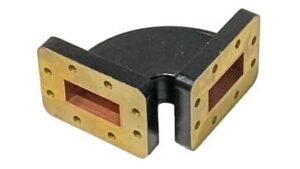
Frequency
Standard rectangular waveguides operate in the TE10 dominant mode, with available bandwidth typically between 1.25 times and 1.90 times the cutoff frequency.
For example, WR-90 covers the X-band (8.2–12.4 GHz), while millimeter-wave WR-10 covers 75–110 GHz.
As frequency increases, the Insertion Loss per unit length of soft waveguides increases significantly, typically 1.5 to 2 times that of rigid copper waveguides of the same size, and due to the reduced cross-sectional area, their average power and peak power handling capabilities drop drastically.
Frequency and Size
Only when the signal frequency is higher than this threshold can electromagnetic waves propagate within the waveguide; otherwise, they attenuate rapidly.
The industry follows EIA standards established by the Electronic Industries Alliance, mapping different frequency ranges to specific WR (Waveguide Rectangular) numbers.
For example, the internal broad wall dimension of WR-90 is 0.900 inches (22.86 mm), and its theoretical cutoff frequency is calculated to be 6.557 GHz.
When frequencies rise to the millimeter-wave band, such as the V-band (50-75 GHz), the corresponding WR-15 waveguide broad wall dimension is only 0.148 inches (3.759 mm).
This strict inverse relationship between size and frequency requires engineers to lock in the operating frequency band at the very beginning of system design, because once a waveguide is selected, its physical channel forms a fixed high-pass filter that cannot be used universally across a wide band like coaxial cables.
EIA WR-650 (L Band): 1.12 – 1.70 GHz, Internal Dimensions 165.10 x 82.55 mm
EIA WR-137 (C Band): 5.85 – 8.20 GHz, Internal Dimensions 34.85 x 15.80 mm
EIA WR-28 (Ka Band): 26.5 – 40.0 GHz, Internal Dimensions 7.11 x 3.56 mm
EIA WR-10 (W Band): 75.0 – 110.0 GHz, Internal Dimensions 2.54 x 1.27 mm
In soft waveguide selection, strictly adhering to standard WR sizes is particularly important because the internal corrugated structure or interlocking segments of the soft waveguide must maintain perfect mechanical alignment with the rigid waveguide flange interfaces connected at both ends.
Any dimensional deviation will form a Step at the connection, leading to impedance mismatch and reflection.
In low-frequency bands (such as L and S bands), waveguide dimensions are huge—the cross-section of WR-284 reaches 72.14 x 34.04 mm—making manufacturing tolerances relatively easy to control.
However, in high-frequency bands, dimensional miniaturization causes tolerance sensitivity to rise exponentially.
For WR-10 or WR-12 soft waveguides operating above 75 GHz, internal dimensions are only a few millimeters.
Minute manufacturing errors (such as ±0.03 mm) or slight compression deformation during installation can cause the cutoff frequency to shift or generate parasitic modes within the band.
The actual usable frequency range is typically limited to between 1.25 times and 1.90 times the cutoff frequency.
Due to their flexible structure, soft waveguides may undergo slight elliptical deformation in cross-section when bent or twisted.
This change in geometric shape destroys the boundary conditions of the rectangular waveguide, causing higher-order modes to be excited at frequency points lower than the theoretical calculation.
Therefore, when selecting soft waveguides, it is recommended to reserve a larger frequency margin than for rigid waveguides, trying to avoid working at the very edges of the frequency band (especially the high-frequency edge) to prevent signal instability during dynamic bending.
Frequency Range Selection Example:
System Center Frequency: 14.2 GHz
Recommended Selection: WR-62 (12.4 – 18.0 GHz)
Avoid Selection: WR-75 (10.0 – 15.0 GHz).
As frequencies enter the millimeter-wave realm (above 30 GHz), the influence of the internal corrugated structure of soft waveguides on electrical size becomes non-negligible.
In low-frequency bands, the depth and period of corrugations are small relative to the wavelength, and the electromagnetic wave mainly “sees” the average inner diameter.
But in Ka, V, and W bands, the wavelength shortens to the millimeter level, and the dimensions of the corrugation structure itself approach a fraction of the wavelength, which causes periodic reflections of waves propagating along the waveguide.
When these minute reflections superimpose in phase at specific frequencies, VSWR spikes will occur within the passband, a phenomenon known as “in-band resonance.”
The higher the frequency, the more pronounced this effect. High-quality millimeter-wave soft waveguides typically use Seamless Electroformed manufacturing processes to obtain smoother inner walls and more precise dimensional control than mechanical interlocking structures, thereby maintaining lower insertion loss and VSWR at high frequencies.
For applications exceeding 50 GHz, if soft waveguides must be used, it is usually recommended to limit the length to within 100 mm or 150 mm, and the bend radius should be strictly controlled above the minimum value allowed by the datasheet, because high-frequency electromagnetic waves are extremely sensitive to any minute compression of the waveguide cross-section.
Bandwidth Effective Range
When the signal frequency is below this value, the waveguide behaves reactively, the propagation constant becomes real, and the electromagnetic wave decays exponentially over a very short distance; this phenomenon is called evanescent modes.
In engineering, to avoid non-linear effects near the cutoff frequency, the lowest usable operating frequency is typically set at around 1.25 times the theoretical cutoff frequency.
In this critical region, the dispersion effect of the waveguide is extremely significant, and group velocity changes drastically with frequency, causing severe phase distortion of broadband signals after transmission.
Furthermore, approaching the cutoff frequency, the characteristic impedance of the waveguide rises sharply, tending towards infinity, making impedance matching with standard 50-ohm coaxial systems physically almost impossible to achieve, resulting in extremely high reflection loss.
Once the system enters a multi-mode transmission state, different modes propagate at different speeds, causing inter-mode interference at the receiving end, leading to drastic fluctuations in signal intensity and data errors.
To ensure Single Mode Operation, the maximum operating frequency recommended by industrial standards is usually limited to within 1.89 or 1.90 times the theoretical cutoff frequency.
However, for soft waveguides, this upper limit often needs to be lowered further.
Since soft waveguides undergo bending, twisting, or stretching during installation, their rectangular cross-section inevitably undergoes minute geometric deformations, such as becoming a rounded rectangle or trapezoid.
This cross-sectional asymmetry destroys the boundary conditions of the electromagnetic field, causing higher-order modes (such as variants of TE11 or TM11) to be excited prematurely at points lower than the theoretical TE20 cutoff frequency.
Therefore, in dynamic bending applications, retaining a larger high-frequency margin is a necessary measure to prevent mode hopping and signal instability.
| Waveguide Model (EIA) | Band | Theoretical Cutoff Freq fc (GHz) | Recommended Min Freq (GHz) | Recommended Max Freq (GHz) | TE20 Higher Order Mode Cutoff Freq (GHz) |
|---|---|---|---|---|---|
| WR-137 | C Band | 4.301 | 5.85 | 8.20 | 8.602 |
| WR-112 | H Band | 5.260 | 7.05 | 10.00 | 10.520 |
| WR-90 | X Band | 6.557 | 8.20 | 12.40 | 13.114 |
| WR-75 | M Band | 7.869 | 10.00 | 15.00 | 15.738 |
| WR-62 | Ku Band | 9.488 | 12.40 | 18.00 | 18.976 |
| WR-42 | K Band | 14.051 | 18.00 | 26.50 | 28.102 |
| WR-28 | Ka Band | 21.077 | 26.50 | 40.00 | 42.154 |
This internal corrugation can be viewed as a series of cascaded microwave resonant cavities or periodic loads. When the wavelength and corrugation pitch meet specific phase conditions, Bragg Reflection occurs.
This leads to a steep increase in insertion loss and Voltage Standing Wave Ratio (VSWR) spikes at specific frequency points within the recommended bandwidth, commonly known as “suck-out points” or “resonant notches.”
For long flexible waveguides (exceeding 24 inches or 60 cm), this effect is particularly pronounced in the millimeter-wave band.
If the application scenario requires covering the full frequency band (e.g., WR-28 needs to cover the full 26.5-40 GHz), one must check the factory VSWR scan curve of the flexible waveguide to confirm that there are no narrow-band resonance spikes across the entire scan range.
Some low-quality flexible waveguides can only guarantee narrow-band operation; when scanned across the full band, VSWR exceeding 1.5:1 or even 2.0:1 may appear at the high-frequency end.
For applications requiring coverage of an octave or even wider bandwidth (such as 6-18 GHz electronic warfare systems), the bandwidth of standard rectangular waveguides (approx. 1.5:1) cannot meet the demand. In such cases, double-ridged flexible waveguides, such as WRD-650 or WRD-180, should be selected.
Ridge waveguides, by adding ridge-like protrusions in the center of the broad wall, lower the cutoff frequency of the dominant mode while significantly raising the cutoff frequency of the first higher-order mode, thereby extending the usable bandwidth to 2.4:1 or even 3.6:1.
However, this bandwidth extension comes at the cost of sacrificing power capacity and increasing insertion loss.
At the same operating frequency, the insertion loss of ridge waveguides is typically 30% to 50% higher than that of standard rectangular waveguides, and due to the concentration of the electric field in the ridge gap, their breakdown voltage threshold is lower.
When selecting, one must carefully weigh the relationship between bandwidth requirements and transmission loss. Except for scenarios that must cover ultra-widebands, standard rectangular waveguides remain the preferred choice.
Frequency Effect on Attenuation
As frequency increases, the Skin Depth of electromagnetic waves significantly decreases, and current is forced to flow in an extremely thin layer on the inner metal surface.
For example, in the X-band at 10 GHz, the skin depth of copper is approximately 0.66 microns, while in the W-band at 100 GHz, this depth shrinks to only 0.20 microns.
The unique Bellows or Interlocking structure of flexible waveguides makes this problem more severe than in rigid waveguides.
In standard rigid waveguides, high-frequency current flows along straight, smooth inner walls, whereas in flexible waveguides, the current must flow up and down along the contour of every corrugation.
This causes the actual physical path length through which the current flows to be much greater than the axial mechanical length of the flexible waveguide.
For common seamless corrugated flexible waveguides, the actual current path length is typically 1.2 to 1.4 times the physical length of the waveguide, which directly introduces additional ohmic losses.
In the millimeter-wave band, the depth and density of corrugations become significant relative to the extremely small cross-sectional dimensions of the waveguide. This path extension effect is further exacerbated, causing the unit length loss of flexible waveguides to typically reach 1.5 to 2.5 times that of rigid waveguides in the same frequency band.
Twistable flexible waveguides are made of spirally wound interlocking metal strips, and their inner surface contains thousands of sliding contact points.
In low-frequency bands (such as L, S, and C bands), the contribution of the contact resistance of these mechanical contact points to the total loss is relatively small.
However, when the frequency exceeds 18 GHz entering the K-band and above, the shortening of the wavelength makes the current path across these interlocking segments extremely sensitive.
Microscopic oxide layers on the metal strip surfaces, uneven contact pressure due to manufacturing tolerances, and contact loosening during dynamic bending can all cause contact resistance to rise sharply, manifesting as significant insertion loss.
Even worse, this loss is often unstable and fluctuates with the bending state of the waveguide (Loss Variation).
In contrast, Seamless flexible waveguides are hydroformed or electroformed from a single metal tube and have no mechanical seams. Therefore, in the Ka-band (26.5-40 GHz) and higher frequencies, their attenuation performance is far superior to twistable structures.
Data indicates that in WR-28 Ka-band, the loss of high-quality seamless flexible waveguides is approximately 0.5 dB/ft, while the loss of twistable waveguides of the same specification may exceed 0.8 dB/ft and is prone to increasing with age.
- L Band (WR-650): Frequency is very low, skin effect is not obvious. The loss difference between rigid and flexible waveguides is mainly determined by the inner wall surface area, with a difference rate typically less than 20%.
- X Band (WR-90): Typical rigid copper waveguide loss is approx. 0.03 dB/ft, seamless flexible waveguide approx. 0.05 dB/ft, twistable flexible waveguide approx. 0.08 dB/ft.
- Ka Band (WR-28): Typical rigid silver-plated waveguide loss is approx. 0.15 dB/ft. Seamless flexible waveguide surges to 0.4-0.6 dB/ft, widening the loss difference to 3-4 times.
- W Band (WR-10): Frequency is extremely high. Rigid waveguide loss already reaches 1.0 dB/ft, while flexible waveguide loss can easily exceed 2.5 dB/ft. Even extremely short lengths bring significant signal attenuation.
When transmitting 1000 watts of CW power in WR-137 (C-band), a loss of 0.05 dB produces very little heat, and the waveguide temperature rise is almost negligible.
But when transmitting 200 watts in WR-28 (Ka-band), if the flexible waveguide loss is as high as 0.5 dB/ft, a 2-foot long flexible assembly will consume about 40 watts of power and convert it into heat.
Since flexible waveguides are usually covered with silicone or neoprene jackets, which are good thermal insulators, they hinder the dissipation of heat from the corrugated metal tube to the external environment.
This causes the internal temperature of the corrugated tube to rise sharply. Metal conductivity decreases as temperature rises (the temperature coefficient of resistivity for copper is approx. 0.00393/°C), leading to further increased loss, forming a positive feedback loop.
Therefore, in high-frequency, high-power applications, the flexible waveguide temperature must be controlled by lowering the ambient temperature or using forced air cooling. Furthermore, an additional thermal loss margin caused by temperature rise must be reserved in the link budget calculation, rather than designing solely based on datasheet specifications at room temperature.
Bend Radius
The bend radius of a flexible waveguide refers to the minimum distance from the centerline to the axis of rotation when the waveguide is bent.
For rectangular waveguides, the E-plane (broad side bend) allows a minimum radius typically only about 50% of the H-plane (narrow side bend) because the physical cross-section is thinner.
Selection must strictly distinguish between Static installation and Dynamic Flexing.
Under static conditions, the E-plane minimum radius for WR-90 is about 64mm, whereas in dynamic applications (like radar gimbals), a larger margin must be reserved according to MIL-DTL-28837 standards; otherwise, it leads to metal fatigue in the corrugated tube, triggering VSWR exceeding 1.15:1 or airtightness failure.
E-Plane and H-Plane
The electric field vector of the TE10 mode is perpendicular to the broad wall of the waveguide (Dimension a) and parallel to the narrow wall (Dimension b).
Therefore, when the waveguide is bent along the plane where the broad wall lies, the direction of the electric field vector aligns with the plane of the bend radius; this type of bend is called an E-plane bend.
From a mechanical mechanics perspective, an E-plane bend effectively deforms the waveguide tube in the direction of its smaller cross-sectional height (i.e., narrow side b).
Since the standard aspect ratio of rectangular waveguides is typically 2:1, bending along the E-plane is equivalent to bending a flat object.
Its cross-sectional moment of inertia is small, the displacement distance of the corrugated tube or interlocking strips under compression on the inside and tension on the outside is relatively short, and the material stress is lower.
Therefore, the E-plane is commonly referred to as the “Easy Way,” allowing for a smaller bend radius.
According to MIL-DTL-28837 specifications, for the same waveguide size, the minimum bend radius for the E-plane is typically only 50% to 60% of the H-plane bend radius. For example, in a WR-137 (C-band) flexible waveguide, the static E-plane minimum bend radius is approximately 102mm, while the H-plane is as high as 203mm.
Opposite to the E-plane, an H-plane bend refers to the waveguide bending along the plane where the narrow side lies, where the plane of the magnetic field loop is parallel to the bending plane.
Structurally, an H-plane bend requires the waveguide to deform in the direction of the broad wall (Dimension a), which is known as the “Hard Way.”
Since the broad side dimension is twice that of the narrow side, when performing an H-plane bend, the radius difference between the inner and outer walls of the waveguide increases significantly, leading to a drastic increase in material expansion and contraction per unit length.
For flexible waveguides with a Seamless Corrugated structure, H-plane bending creates extremely high stress concentrations at the peaks and troughs of the corrugations.
If the bend radius is smaller than the limit specified in the data sheet, the inner corrugated tube will undergo “Buckling” or overlapping, causing the internal cross-section of the waveguide to lose its rectangular shape.
In higher frequency millimeter-wave bands, such as WR-28 (Ka-band, 26.5-40 GHz), the inner wall dimensions are only 7.112 x 3.556mm.
Any slight excessive H-plane bending can cause the tube wall to collapse, subsequently shifting the Cutoff Frequency and producing irreversible high VSWR reflections.
In actual routing engineering, different planes of bending result in different physical path differences for the waveguide’s effective electrical length.
When a flexible waveguide is in an H-plane bend, because its Neutral Axis is farther from the inner wall, maintaining the same bend angle (e.g., 90 degrees) requires a significantly longer arc length than an E-plane bend.
Designers must refer to the specific model’s Bend Radius vs. Phase Stability curve.
For Twistable flexible waveguides, typically made of wound silver-plated brass strips, H-plane bending causes a sharp increase in friction between the interlocking structures.
Frequent dynamic H-plane bending accelerates the wear between the internal rubber jacket and the metal strips, leading to airtightness failure.
Data shows that in dynamic applications, violating the H-plane minimum bend radius limit is the primary cause of flexible waveguide fracture within 10,000 cycles, whereas with the correct radius, similar products can maintain over 100,000 bending cycles.
In scenarios with multiple bends or Compound Bends, the interaction between E-plane and H-plane is more complex.
If a flexible waveguide needs to complete turns in both E-plane and H-plane within a single path, a sufficient straight transition section (Tangent Length) must be reserved between these two bend points.
It is generally recommended that the transition length be at least 3 times the waveguide broad wall dimension (Dimension a).
If the two bend points are too close, the residual stress from the first bend will superimpose onto the next bend point, causing the material to enter the plastic deformation zone.
This superposition effect is particularly obvious in large waveguides of WR-75 and above.
If space constraints prevent reserving a transition section, engineering practice usually prioritizes using a combination of prefabricated rigid elbows and straight flexible waveguides rather than forcibly twisting a single flexible waveguide, because the H-plane radius of rigid elbows can typically be made very small, thereby avoiding the physical shortcomings of flexible waveguides in H-plane bending.
Only when the waveguide is in a straight state is its rated Power Handling 100%. When the waveguide undergoes H-plane bending and approaches the minimum radius limit, the peak power capacity may drop by 15% to 20% due to local electric field enhancement caused by internal geometric deformation. In high-power radar transmitter feed design, this Derating Factor must be accounted for.
Electroformed flexible waveguides, due to their extremely thin walls and uniform material, offer the best VSWR stability in E-plane and H-plane, but have the lowest mechanical strength;
Mechanically Interlocking flexible waveguides, when bent in the H-plane, experience minute slippage in the gaps between adjacent metal strip buckles.
While this slippage provides flexibility, it also introduces the risk of Passive Intermodulation (PIM) interference.
In satellite communication Uplinks, to prevent PIM products from falling into the receiving band, H-plane bending angles are usually strictly limited, or seamless corrugated types are used instead.
Static vs Dynamic
Static bending involves only the material’s single plastic deformation capability, typically referring to a one-time bend of the flexible waveguide during installation to compensate for flange Misalignment or to bypass obstacles. Once installed, the waveguide itself does not undergo relative displacement.
In this scenario, the Bellows or Interlocking Strip withstands constant residual stress.
As long as this stress does not exceed the material’s fracture strength and the bend radius remains above the “Static Min Radius” limit, the internal physical structure of the waveguide remains stable.
Manufacturers testing static radius typically bend the waveguide to the limit and hold it for 24 hours, observing whether the jacket cracks and if VSWR degrades.
In contrast, dynamic bending targets applications such as radar gimbals, mobile satellite antennas, or airborne pods, where the flexible waveguide must undergo tens of thousands or even millions of reciprocating motions over the equipment’s lifecycle.
Under these conditions, the failure mechanism shifts to Low Cycle Fatigue or high cycle fatigue.
The waveguide metal walls develop Work Hardening during repeated tension and compression cycles, leading to reduced ductility and eventually micro-cracks.
Based on MIL-DTL-28837 military standards, the dynamic minimum bend radius value for the same flexible waveguide is typically set at 2 times or even 3 times the static radius to ensure the stress amplitude always remains within the material’s Infinite Life Region.
Taking a standard WR-90 (X-band, 8.2-12.4 GHz) seamless flexible waveguide as an example, its E-plane static minimum bend radius is typically labeled as 64mm, allowing for relatively large single adjustments;
However, in dynamic applications, the E-plane bend radius is strictly restricted to above 200mm. If forced to undergo dynamic cycling at a 100mm radius, stress concentration points at the corrugation peaks will initiate penetrating cracks within 10,000 cycles, causing leakage of internal pressurized dry air or even waveguide fracture.
Dynamic bending must also consider frequency (Cyclic Rate), i.e., the number of bends per minute. High-frequency rapid bending prevents friction heat inside interlocking waveguides from dissipating in time, leading to softening failure of the internal rubber or polymer jacket, thereby losing support for the metal structure.
Electrical performance varies greatly under static versus dynamic conditions, which directly affects the calculation margin for link budgets.
In static installation, once the waveguide is fixed, its Insertion Loss and Phase Length are constant values, requiring no further compensation after system calibration.
During dynamic bending, however, the waveguide’s physical length and internal capacitance structure change minutely with the bending angle, causing transmission phase jitter.
For phase-sensitive systems (such as phased array radars or interferometers), specifically designed “High Flex” or “Phase Stable” grade waveguides must be selected.
When ordinary flexible waveguides are dynamically bent to the limit radius, phase change can exceed +/- 10 degrees, while high-grade dynamic waveguides, through optimized corrugation shapes and increased jacket rigidity, can control phase change to within +/- 2 degrees.
Furthermore, when Twistable flexible waveguides are dynamically bent, the contact points between internal metal strips constantly change, potentially generating micro-discharges or poor contact, leading to instantaneous increases in Passive Intermodulation (PIM) products that interfere with receiver sensitivity—a phenomenon almost non-existent in static applications.
| Waveguide Model (EIA) | Band (Frequency) | Construction Type | Static E-Plane Min Radius | Static H-Plane Min Radius | Dynamic E-Plane Min Radius | Dynamic H-Plane Min Radius |
|---|---|---|---|---|---|---|
| WR-137 | 5.85 – 8.20 GHz | Flex-Twist (Interlocking) | 102 mm | 203 mm | 406 mm | 508 mm |
| WR-112 | 7.05 – 10.0 GHz | Seamless | 89 mm | 178 mm | 267 mm | 534 mm |
| WR-90 | 8.20 – 12.4 GHz | Flex-Twist (Interlocking) | 64 mm | 127 mm | 254 mm | 381 mm |
| WR-75 | 10.0 – 15.0 GHz | Seamless | 51 mm | 102 mm | 153 mm | 305 mm |
| WR-62 | 12.4 – 18.0 GHz | Flex-Twist (Interlocking) | 41 mm | 85 mm | 165 mm | 250 mm |
| WR-42 | 18.0 – 26.5 GHz | Seamless | 25 mm | 51 mm | 76 mm | 152 mm |
Note: The data in the table above synthesizes standard specifications from several mainstream manufacturers (e.g., Mega Industries, Penn Engineering). Actual values may float by +/- 10% depending on jacket material (Neoprene vs Silicone) and wall thickness. Dynamic radius is typically defined as the minimum safe value satisfying over 100,000 full-stroke cycles.
In the system integration phase, confusing static and dynamic parameters is a frequent cause of Field Failure.
Designers often, due to space constraints, reference the smaller “static radius” values on the Datasheet to design the active space for dynamic motion mechanisms, leading to mechanical fatigue of the waveguide in the early stages of operation.
For complex dynamic systems requiring simultaneous movement in two axes, one must not only adhere to the dynamic bend radius of a single plane but also calculate the Twist component generated by compound motion.
Standard rectangular flexible waveguides are extremely sensitive to twisting, typically allowing a twist of only 15 degrees/ft (Static) and 5 degrees/ft (Dynamic).
If the dynamic application includes unavoidable twisting actions, specialized circular waveguide Rotary Joints must be used in conjunction with flexible waveguides, or a dual-waveguide section structure used to decouple motion vectors.
It is strictly forbidden to rely on the torsional flexibility of the soft waveguide itself to absorb long-term rotational stress.
The choice of jacket material should also depend on the dynamic environment. Neoprene is suitable for most static and low-frequency dynamic applications, while Silicone, due to its low-temperature elasticity and UV resistance, is more suitable for high-frequency dynamic applications in high-altitude or extreme cold environments, effectively preventing brittle fracture of the jacket during low-temperature dynamic bending.