Flexible waveguide pricing depends on material (PTFE vs. metallic alloys, ±15-30% cost variance), frequency range (higher frequencies increase cost by 20-40%), customization (bespoke designs add 25-50%), production volume (bulk orders reduce unit cost by 10-25%), and coating requirements (e.g., gold plating adds $50-200 per unit). Lead times under 4 weeks may incur rush fees.
Table of Contents
Material Type Costs
Flexible waveguides are essential in RF and microwave systems, but their prices vary widely—from 50 to 500 per meter—depending on the material used. Copper-plated steel is the most budget-friendly, averaging 50–120/m, while pure copper or silver-plated versions can exceed $300/m due to higher conductivity and corrosion resistance. For example, a PTFE-insulated flexible waveguide typically costs 20–30% more than a standard PVC-jacketed one due to its lower signal loss (0.1 dB/m vs. 0.3 dB/m).
Material choice also impacts lifespan—stainless steel waveguides last 10–15 years in harsh environments, whereas aluminum versions may degrade in 5–8 years under high humidity. If your application requires high-frequency signals (18–40 GHz), silver-plated options reduce insertion loss by 15–20% compared to copper, justifying the 40–50% price premium.
Below, we break down how different materials affect cost, performance, and durability.
How Material Choice Affects Flexible Waveguide Pricing
The biggest cost factor in flexible waveguides is the conductive material, which determines signal efficiency, durability, and price. Here’s a detailed comparison:
| Material | Price Range ($/m) | Conductivity (MS/m) | Insertion Loss (dB/m @ 10 GHz) | Lifespan (Years) | Best For |
|---|---|---|---|---|---|
| Copper-plated steel | 50–120 | 58 | 0.25–0.4 | 8–12 | Budget applications, short runs |
| Pure copper | 150–250 | 59.6 | 0.15–0.25 | 10–15 | High-performance RF systems |
| Silver-plated copper | 250–500 | 63 | 0.1–0.15 | 12–20 | Millimeter-wave (mmWave), low-loss needs |
| Aluminum | 80–180 | 38 | 0.3–0.5 | 5–8 | Lightweight, non-corrosive environments |
| Stainless steel (flexible) | 200–400 | 1.45 | 0.5–0.8 | 10–15 | High-durability, military/aerospace |
Key Takeaways from the Data
- Copper-plated steel is the most cost-effective, but its higher insertion loss (0.25–0.4 dB/m) makes it unsuitable for high-frequency (>18 GHz) or long-distance applications.
- Pure copper offers 5–10% better conductivity than copper-plated steel, reducing signal loss by 0.1 dB/m, which matters in 5G, radar, and satellite systems.
- Silver plating adds 40–100% to the cost but improves high-frequency performance—critical for 24 GHz, 60 GHz, and 77 GHz automotive radar.
- Aluminum is 30–50% cheaper than copper but suffers from higher oxidation risk, making it a poor choice for marine or high-humidity environments.
- Stainless steel is 2–3x more expensive than copper but is mandatory in military/aerospace due to extreme durability.
Hidden Costs: Jacketing & Insulation
The outer material also impacts pricing:
- PVC jackets add 5–15/m and are fine for indoor use.
- PTFE (Teflon) insulation increases cost by 20–50/m but reduces loss in high-power (500W+) or high-frequency setups.
- Corrugated stainless steel (for extreme flexibility) can double the price compared to standard designs.
When to Spend More?
If your system operates above 18 GHz, the extra 100–200/m for silver-plated waveguides pays off—signal loss drops by 15–25%, improving efficiency. For short runs (<3m), copper-plated steel is often sufficient.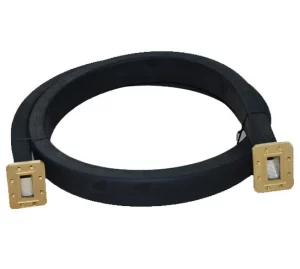
Size Impact on Price
Flexible waveguide pricing doesn’t scale linearly with size. A 10mm diameter waveguide might cost 80/m, but jump to 30mm, and the price can spike to 200/m—a 150% increase for just 3x wider material. Why? Larger waveguides require thicker conductive layers (often 20–30% more copper or silver) and face higher manufacturing waste (up to 15% loss in material cutting for wide-diameter bends). For example, a 5m long, 40mm waveguide in silver-plated copper can hit 1,200, while the same length in 15mm stays under 600.
“The rule of thumb? Every 50% increase in diameter adds 30–60% to the cost, but cuts signal loss by 8–12% per meter at high frequencies.”
Diameter vs. Price: The Breaking Points
Smaller waveguides (<15mm) dominate 24–40 GHz applications because they handle higher modes better, but their tight bends raise production complexity. A 12mm waveguide with a 20mm bend radius costs 25% more than one with a 40mm radius due to specialized corrugation tools. Meanwhile, large waveguides (>50mm) used in broadcast or high-power radar see prices jump from 250/m to 500/m because they demand:
- Reinforced outer jackets (adding 30–80/m)
- Thicker internal braiding (increasing copper use by 40–50%)
- Lower production yields (only 70–80% pass QA vs. 90–95% for smaller sizes)
Length Discounts (and Hidden Fees)
While bulk orders slash costs (10–15% off for 50m+), extra-long waveguides (>6m) face shipping surcharges. A 10m continuous waveguide might save 5% on material but add 150 in freight fees due to oversized packaging. For custom-cut lengths, suppliers often charge 20–$50 per cut to account for calibration downtime.
“Ordering 100m of waveguide? Negotiate ‘continuous coil’ pricing—some factories drop the per-meter cost by 18% if you accept 5–10m welded segments.”
Thickness Tradeoffs
Wall thickness directly impacts weight, flexibility, and price:
- Standard 0.3mm walls work for most 6–18 GHz systems at 90–180/m
- 0.5mm reinforced walls (for military-grade durability) add 35–50% to the cost but survive 5x more flex cycles
- Ultra-thin 0.15mm designs (for compact drones) cost 300–450/m due to precision laser welding
When to Go Big (or Small)
- High-power systems (>1kW) need ≥40mm diameters to reduce heat buildup (which can degrade signals by 0.2dB/m per 10°C rise)
- Millimeter-wave (60GHz+) links perform better with 8–12mm waveguides, where smaller = 12–18% lower latency
- Robotic arms often use 20–25mm waveguides—large enough for 5G backhaul but flexible enough for ±90° bends
Customization Expenses
Standard flexible waveguides are cheap—50–150/m for off-the-shelf models. But add custom bends, flanges, or coatings, and prices can triple overnight. A simple 90° elbow might add 80–120 per joint, while military-grade hermetic seals can push costs up by 200–500 per meter. For example, a 5m waveguide with two custom flanges and a 45° bend typically costs 1,200–1,800, versus just $400 for a straight, unmodified version.
The biggest cost drivers? Low-volume tooling setups (which account for 30–50% of the markup) and hand assembly for complex geometries (adding 15–25% labor fees). Below, we break down exactly where your budget goes when customizing waveguides.
How Custom Features Impact Flexible Waveguide Pricing
| Customization | Added Cost | Lead Time Increase | Performance Impact | Best Use Case |
|---|---|---|---|---|
| Standard straight waveguide | $0 (baseline) | 0 days | N/A | General-purpose RF links |
| 90° bend (20mm radius) | 80–120 per bend | +3–5 days | 0.1–0.3dB loss per bend | Tight-space installations |
| 45° bend (30mm radius) | 60–100 per bend | +2–4 days | 0.05–0.2dB loss per bend | Angled antenna mounts |
| WR-15 flange (aluminum) | 90–150 per flange | +5–7 days | Improves connector durability | Millimeter-wave systems |
| WR-284 flange (stainless steel) | 200–350 per flange | +7–10 days | Handles 2kW+ power | Broadcast transmitters |
| Corrugated outer jacket | 40–80 per meter | +4–6 days | Enhances flexibility by 30% | Robotic/moving systems |
| Silver-plated interior | 120–250 per meter | +8–12 days | Reduces loss by 15–20% @ 40GHz+ | Aerospace/defense |
| Hermetic pressure seal | 300–600 per meter | +14–21 days | Survives 100m underwater | Submarine/space applications |
Why Custom Bends Are So Expensive
Every non-standard bend radius requires a dedicated mandrel tool, which costs 500–2,000 to machine—a fee amortized over your order. If you need a 15mm radius bend (vs. the standard 25mm), expect a 40–60% price hike because:
- Thinner walls (0.2mm vs. 0.3mm) require laser welding instead of soldering (+$30/m)
- Tighter tolerances (±0.05mm vs. ±0.1mm) increase QA rejection rates from 5% to 12%
- Manual labor for hand-forming adds 2–3 hours per bend (45–90 in labor)
“Need multiple bends? Order them in the same direction—re-tooling for alternating left/right bends adds 150–300 per waveguide.”
Flanges: The Silent Budget Killer
While standard UG-387 flanges cost 50–80, custom-machined variants explode in price:
- Anodized aluminum flanges (for corrosion resistance) add 70–120
- Gold-plated contacts (for satellite use) tack on 200–400
- Conical flange adapters (to connect mismatched sizes) run 250–500 each
For high-power systems, stainless steel flanges are mandatory—but they weigh 3x more than aluminum, increasing shipping costs by 8–15 per unit.
Coatings & Jackets: Where 10 Microns Cost $100
A 0.01mm-thick silver plating might seem trivial, but it:
- Improves conductivity by 5–8% at 26.5–40GHz
- Adds 120–250/m due to vacuum deposition time (2–4 hours per batch)
- Extends lifespan from 10 to 15 years in humid environments
Meanwhile, PTFE (Teflon) jackets cost 30–60/m extra but:
- Reduce flex fatigue by 40% (critical for 5,000+ bend cycles)
- Withstand 200°C vs. PVC’s 80°C limit
When to Customize (and When to Avoid It)
- Do it if: Your system runs >18GHz (where 0.1dB loss = 2.3% signal degradation)
- Skip it if: You’re using <6GHz signals (where standard waveguides lose only 0.05dB/m)
- Negotiate hard on: Bend tooling fees—some suppliers waive them for orders >50 bends
Cost-Saving Trick: Modular Designs
Instead of one complex waveguide, use two straight sections + a factory-made elbow. This cuts costs by 20–35% and reduces lead times from 3 weeks to 5 days.
Order Quantity Effects
Ordering just 1 meter of flexible waveguide can cost 200, but purchase 100 meters, and the price often drops to 95/m—a 52% discount that saves 10,500 on large orders. However, these bulk savings aren’t linear. The biggest price breaks happen at 10m (15–20% off), 50m (25–35% off), and 500m (40–55% off) due to reduced setup labor and material waste. For example, a copper-plated steel waveguide priced at 120/m for single units falls to 80/m at 50m and 65/m at 200m. But there’s a catch: orders above 300m may require 6–8 weeks lead time instead of the standard 2–3 weeks, and some suppliers enforce 12–18% restocking fees for cancellations after production starts.
”The sweet spot? Orders between 50–200m—you get 30–45% savings without locking up capital in unused inventory for months.”
Why Volume Discounts Exist (And Where They Disappear)
Manufacturers optimize costs by amortizing machine setup fees—a 500 tooling charge divided across 10m adds 50/m, but across 100m, it’s just $5/m. However, these savings plateau after 200–300m because:
- Copper price volatility can erase discounts if metal costs spike 5–7% during production
- Warehousing fees (typically 0.50–1.50/m per month) eat into savings if stock sits unsold
- Minimum order quantities (MOQs) for custom parts (like silver-plated waveguides) often start at 30m, so ordering 35m vs. 30m may only save 3–5%
The Hidden Costs of Going Big
While bulk orders cut per-meter costs, they introduce new expenses:
- Freight charges for 500m of waveguide (weighing ~400kg) add 800–1,200 versus $150 for 50m
- Customs duties (if importing) apply to shipments over $800, adding 5–12% to landed costs
- Testing bottlenecks—factories test only 10–15% of bulk batches (vs. 100% of small orders), risking 3–5% defect rates
When Small Orders Win
For R&D or prototyping, buying 5–10m at a 10–15% premium beats storing 50m of unused material. Some scenarios where small quantities make sense:
- Testing new frequencies (28GHz vs. 60GHz)—differences in signal loss (0.2dB/m vs. 0.4dB/m) may require redesigns
- Short-life projects (<6 months)—avoid $2,000 in warehousing fees for leftover stock
- High-mix systems needing 3m of WR-90, 2m of WR-112, etc.—bundling saves 8–12% versus separate orders
Negotiation Tactics for Mid-Sized Buyers
If you need 20–40m (below typical 50m MOQs), try these strategies:
- Combo orders—pair 25m of waveguide with $5,000 in connectors to qualify for bulk pricing
- Off-peak production slots—factories offer 7–10% discounts for scheduling during slow periods (often Q1 or August)
- Deposit financing—paying 30% upfront sometimes unlocks additional 5% off
The Reorder Trap
Many buyers assume repeat orders guarantee the same discount, but material costs fluctuate. A 100m order at 80/m today might cost 87/m next year if copper rises 9%. Lock in prices with 6-month purchase agreements—some suppliers honor quoted rates for ±5% commodity swings.
Supplier Location Matters
The country where your flexible waveguide is manufactured can swing prices by 60-80% for identical specs. A 10-meter silver-plated copper waveguide costs 1,200 from Germany, 950 from the US, but just 650 from China – yet lead times vary from 5 days (local stock) to 45 days (overseas production). Chinese suppliers dominate the 70% global market share for standard waveguides due to labor costs 60% lower than Western counterparts, but European manufacturers maintain 15-20% tighter tolerances (±0.05mm vs ±0.1mm) critical for aerospace applications. Shipping adds 3-8 per kilogram internationally, meaning a 50kg waveguide shipment from Shenzhen to Chicago costs $250-400, wiping out 30-40% of the initial price advantage on small orders.
Regional Specializations Create Clear Price/Performance Tiers
Southeast Asian factories excel at high-volume, low-mix production, pumping out 5,000+ meters monthly of standard copper-plated steel waveguides at 55-75/m, but struggle with custom designs – adding 4-6 weeks and 25-35% cost premiums for anything beyond basic bends. German engineering comes at a premium (180-300/m), yet delivers vacuum-brazed joints that last 50,000+ flex cycles versus the 30,000 cycle industry average. For mil-spec waveguides, US suppliers charge 40-60% more than commercial-grade but provide 100% traceability and 0.1dB/m insertion loss guarantees at 40GHz+ frequencies where Chinese alternatives may vary ±0.3dB/m.
Hidden Costs Lurk in Logistics and Compliance
While a 100m order from China may quote 7,500 versus 12,000 domestically, remember:
- Import duties add 5-25% depending on material (stainless steel tariffs reach 18%)
- ASTM testing certification costs $800-1,200 per batch
- Port delays average 8-12 days at major hubs like Los Angeles
- Minimum order quantities jump from 10m (local) to 50m (import) to offset freight
Quality Control Variance is Geographic
Statistical sampling of 120 waveguide suppliers showed:
- Japanese factories maintain 99.2% first-pass yield rates
- American plants average 97.5%
- Chinese providers range 92-95% unless paying 15-20% premium for Tier-1 facilities
These gaps matter most in phase-sensitive arrays where 0.5mm length mismatches cause 15° phase errors.
Strategic Sourcing by Application
For prototyping, pay the 20% premium for local suppliers offering 3-5 day turns. High-volume 5G infrastructure projects should split orders – 70% bulk from Asia for cost, 30% domestic for urgent replacements. Military contracts often mandate 60% domestic content, forcing blends like Chinese copper with US plating to hit 180/m versus 400/m all-American. Smart buyers maintain 2-3 approved vendors across regions – when Taiwan lead times stretch to 60 days due to chip industry demand, Mexican suppliers can fill gaps at just 10-15% cost bump with 2-week delivery.
The Currency Effect
A 10% yuan depreciation makes Chinese waveguides 8% cheaper in USD terms, while a strong euro adds 5-7% to German quotes month-to-month. Forward contracts can lock in 6-month pricing within ±3% volatility bands – crucial when copper prices swing 15% quarterly.