The 6 most widely used RF cable connectors are SMA (0-18 GHz, 50Ω), common in WiFi and cellular devices; BNC (0-4 GHz, 50/75Ω), favored for test equipment; N-type (0-11 GHz, 50Ω), ideal for high-power applications; TNC (0-11 GHz), a threaded BNC variant; SMB (0-4 GHz), used in compact electronics; and F-type (0-1 GHz, 75Ω), standard for TV/satellite.
These cover 90%+ of commercial RF applications, with key differences in frequency range, impedance, and power handling (e.g., N-type handles 500W+ at 1GHz). Always match connector gender (male/female) and use proper torque (e.g., 8 in-lbs for SMA) to prevent signal loss.
Table of Contents
SMA Connector Basics
SMA connectors are one of the most widely used RF coaxial connectors, especially in applications requiring up to 18 GHz frequency range and compact size. Originally developed in the 1960s, these connectors are now standard in Wi-Fi routers (2.4 GHz and 5 GHz bands), cellular antennas (1.7–2.5 GHz), and test equipment (up to 6 GHz for most handheld analyzers). The typical insertion loss for a high-quality SMA connector is 0.1 dB at 6 GHz, making them efficient for short-range signal transmission.
A standard SMA connector has a 50-ohm impedance, though some variants (like SMA 75-ohm) exist for specific applications. The male version (plug) uses a 3.5 mm outer diameter threaded coupling nut, while the female version (jack) has a matching internal thread. Mating cycles for SMA connectors typically range between 500 and 1,000 connections before wear affects performance. Cheaper versions made with brass or nickel-plated bodies may degrade faster, while gold-plated contacts improve longevity, especially in high-frequency environments.
One key limitation is power handling—SMA connectors are rated for around 500 watts peak power at lower frequencies (1 GHz), but this drops sharply to less than 100 watts at 10 GHz due to increased signal loss. For outdoor use, stainless steel or corrosion-resistant variants are preferred, as standard SMA connectors can fail within 2–3 years in humid conditions. Despite their small size, SMA connectors can handle VSWR (Voltage Standing Wave Ratio) below 1.3:1 up to 12 GHz, making them reliable for precision RF work.
A common mistake is over-tightening, which can deform the center pin and increase insertion loss by up to 0.5 dB. The recommended torque for hand-tightening is 7–10 inch-pounds, while a wrench should not exceed 12 inch-pounds. For lab-grade applications, precision SMA connectors (like 3.5 mm or 2.92 mm) offer better performance but cost 3–5x more than standard versions.
BNC Uses and Types
BNC (Bayonet Neill-Concelman) connectors are the go-to choice for quick-connect RF and video applications, handling frequencies up to 4 GHz with a 50-ohm impedance (or 75-ohm for video). These connectors dominate CCTV systems (90% of analog cameras use BNC), test equipment (oscilloscopes, signal generators), and amateur radio setups (144–440 MHz bands). A standard BNC connector can withstand 500+ mating cycles before wear degrades performance, and its bayonet locking mechanism ensures secure connections in under 1/4 turn, making it ideal for field work.
The key advantage of BNC over SMA or N-type is speed—a full connection takes <2 seconds, compared to 5–10 seconds for threaded connectors. However, its power handling is limited to ~100 watts at 1 GHz, dropping to ~30 watts at 2 GHz due to increased skin effect losses. For video signals (75-ohm variants), insertion loss is <0.2 dB at 100 MHz, but rises to 1.5 dB at 3 GHz, making it unsuitable for high-frequency RF beyond 4 GHz.
| Type | Impedance | Max Frequency | Power Handling (1 GHz) | Typical Use Case | Price Range |
|---|---|---|---|---|---|
| Standard BNC | 50-ohm | 4 GHz | 100W | RF test equipment | 5 |
| 75-ohm BNC | 75-ohm | 3 GHz | 50W | CCTV, SDI video | 3 |
| Mini BNC | 50-ohm | 2 GHz | 30W | Compact devices | 8 |
| High Voltage | 50-ohm | 1 GHz | 500W | RF amplifiers | 20 |
Material quality heavily impacts longevity—cheap zinc-alloy BNCs corrode after 1–2 years outdoors, while nickel-plated brass versions last 5+ years. For lab-grade precision, gold-plated contacts reduce insertion loss by ~0.05 dB but add 20–30% to the cost. A common failure point is the center pin retention spring, which weakens after 300+ insertions in low-cost models, causing intermittent signals.
BNC connectors are not waterproof by default—IP67-rated versions (with silicone seals) cost 2–3x more but survive humidity >90% and temperatures from -40°C to +85°C. In broadcast trucks, double-shielded 75-ohm BNCs are mandatory to reduce EMI, adding 4 per connector versus standard versions.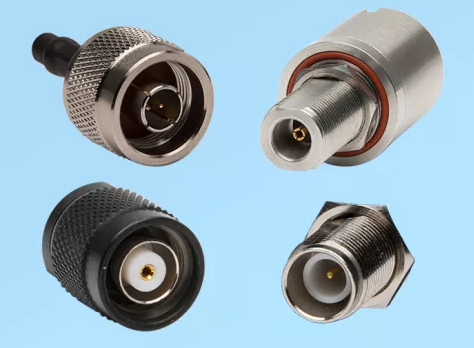
N Connector Features
The N connector (Neill-Concelman) is the heavy-duty workhorse of RF connections, designed in the 1940s but still dominating cellular base stations (1–6 GHz), military comms, and high-power radio (up to 11 GHz). With a 7–16 mm threaded coupling nut, it’s 3x larger than SMA but handles 5x more power—2,700 watts peak at 1 GHz, dropping to 300 watts at 10 GHz due to dielectric heating.
Key fact: A quality N connector maintains <1.15:1 VSWR up to 18 GHz in precision variants (like 7/16″ N), outperforming SMA and BNC for high-frequency stability.
N connectors use 50-ohm impedance as standard, but 75-ohm versions exist for legacy video (now rare). The mating cycle lifespan exceeds 1,000 connections for nickel-plated models, while gold-plated center contacts reduce insertion loss to 0.05 dB at 3 GHz—critical for 5G small cells (3.5 GHz band).
Outdoor durability is a standout feature:
- Stainless steel N connectors survive salt spray tests for 500+ hours (vs. 100 hours for zinc-alloy).
- Operating range: -65°C to +165°C, making them ideal for arctic radar or desert comms.
- IP68-rated versions withstand 30-meter water immersion for 24 hours, costing 50 versus 15 for basic versions.
Power handling drops sharply with frequency:
- At 2 GHz: 1,500 watts
- At 6 GHz: 500 watts
- At 10 GHz: 150 watts
Despite bulkiness, N connectors are 30% cheaper than equivalent SMA assemblies for high-power apps. In LMR (Land Mobile Radio) systems, they’re the default for tower-mounted amplifiers (300W avg.), thanks to gas-tight interfaces preventing oxidation over 10+ years.
Weak point: The hex nut design requires 15 lb-in torque—overtightening cracks dielectric insulators, increasing VSWR by 0.3:1. For phase-sensitive arrays, use torque wrenches (12 lb-in optimal) to maintain ±2° phase stability across 100+ connectors.
TNC Connector Differences
TNC (Threaded Neill-Concelman) connectors are the threaded, weather-resistant cousins of BNC, designed for vibration-prone environments like aircraft radios (108–400 MHz), marine radar (2–4 GHz), and mobile antennas. With a 50-ohm impedance and frequency range up to 11 GHz, they outperform BNC in high-vibration scenarios, maintaining <1.3:1 VSWR at 6 GHz versus BNC’s 1.5:1 limit at 4 GHz.
The key advantage is the threaded coupling mechanism, which reduces accidental disconnects by 90% compared to BNC’s bayonet lock—critical for helicopter comms (500+ Hz vibration environments). However, this comes at a 20–30% higher cost (12 per connector vs. 5 for BNC).
| Feature | TNC Connector | BNC Connector | N Connector |
|---|---|---|---|
| Frequency Range | 0–11 GHz | 0–4 GHz | 0–11 GHz |
| Power Handling | 500W @ 1 GHz | 100W @ 1 GHz | 2,700W @ 1 GHz |
| Mating Mechanism | Threaded (1/4 turn) | Bayonet (1/4 turn) | Threaded (full turn) |
| Vibration Resistance | 50G vibration proof | 10G vibration rated | 30G vibration rated |
| Price Range | 12 | 5 | 20 |
Material choices significantly impact performance:
- Standard TNC (brass/nickel-plated): Lasts 800+ mating cycles, suitable for indoor telecom (5G RRUs)
- Military-grade (stainless steel): Survives salt fog for 1,000+ hours, used in naval systems
- Gold-plated contacts: Reduce insertion loss to 0.07 dB at 6 GHz, but cost 2x more
Power handling drops with frequency:
- At 2 GHz: 300W
- At 6 GHz: 100W
- At 10 GHz: 50W
For phase-sensitive arrays, TNC’s ±5° phase stability is worse than N-type’s ±2°, but better than BNC’s ±10°. In satellite ground stations, TNC is preferred over BNC for L-band (1–2 GHz) feeds due to lower PIM (Passive Intermodulation) <-150 dBc.
SMB Size and Uses
SMB (SubMiniature version B) connectors are the compact workhorses of low-frequency RF, designed for space-constrained applications like GPS modules (1.2–1.6 GHz), automotive telematics (400–800 MHz), and industrial sensors (2.4 GHz Zigbee). Measuring just 4.2 mm in diameter, they’re 40% smaller than SMA connectors but sacrifice frequency range, topping out at 4 GHz with a 50-ohm impedance (75-ohm variants exist for video). Their snap-on coupling mechanism allows 5x faster connections than SMA—critical for assembly line testing, where workers mate 500+ connectors per hour.
The key advantage is durability in tight spaces: SMB connectors survive 1,000+ insertion cycles even when subjected to 10G vibrations, making them ideal for engine control units (ECUs) in vehicles. However, their power handling is limited to 25 watts at 1 GHz, dropping to 5 watts at 4 GHz due to increased resistive losses. Insertion loss is 0.3 dB at 2 GHz, but cheaper brass-bodied versions can degrade to 0.8 dB after 300 cycles as the snap-lock spring weakens.
Material choices directly impact performance:
- Nickel-plated brass is standard for indoor use (85% humidity tolerance), costing 2 per connector.
- Stainless steel variants handle -40°C to +125°C in automotive apps but cost 3x more (6).
- Gold-plated contacts reduce insertion loss by 0.1 dB but add 20% to the price.
In 5G small cells, SMB connectors are often used for GPS synchronization inputs (1.575 GHz) due to their compact size and 0.2 dB loss at this frequency. However, they’re avoided for main RF paths due to PIM (Passive Intermodulation) levels of -120 dBc, which can interfere with LTE Band 7 (2.6 GHz) signals.
A common failure mode is snap-lock wear: after 800+ insertions, the retention force drops from 4 Newtons to <1 Newton, causing intermittent signals. For mission-critical apps, SMB-HD (High Durability) versions extend lifespan to 2,500 cycles but cost 2.5x more.
Despite limitations, SMB dominates automotive CAN bus networks (500 kHz–2 MHz) because its vibration resistance outperforms SMA by 3x. In medical IoT devices, its 4.2 mm diameter fits inside endoscope control units where SMA connectors would be 50% too large.
Weaknesses:
- Frequency ceiling: Not suitable for Wi-Fi 6E (6 GHz) or mmWave.
- Power limits: Unsafe for RF amplifiers >25W.
- Snap-lock fragility: Repeated use in field testing leads to higher failure rates than threaded connectors.
For low-power, compact, and vibration-resistant needs below 4 GHz, SMB delivers 90% of SMA’s performance at 60% of the size and cost. In automotive radar (24 GHz), though, engineers upgrade to 2.92 mm connectors to avoid 1.8 dB loss per connection.
F Connector for TV
The F connector is the standard coaxial interface for TV signals worldwide, handling 54–1002 MHz (North American cable TV bands) and 470–862 MHz (DVB-T terrestrial TV) with 75-ohm impedance. Over 95% of cable set-top boxes and 80% of flat-panel TV antennas use this connector due to its simple screw-on design and low cost (0.50 per unit). Unlike RF connectors, F connectors are optimized for video bandwidth, with insertion loss of <0.5 dB at 800 MHz—critical for maintaining SNR >30 dB in digital TV signals.
| Type | Frequency Range | Insertion Loss (800 MHz) | Power Handling | Typical Use Case | Price Range |
|---|---|---|---|---|---|
| Standard F | 0–1 GHz | 0.4 dB | 10W | Cable TV boxes | 0.30 |
| Weatherproof F | 0–1 GHz | 0.5 dB | 10W | Outdoor satellite dishes | 1.50 |
| Push-on F | 0–900 MHz | 0.7 dB | 5W | Indoor TV antennas | 0.20 |
| HDMI Hybrid F | 0–3 GHz | 0.3 dB | 15W | 4K/8K broadcast equipment | 5 |
The center conductor is the cable’s inner wire itself, eliminating contacts that add 0.1–0.2 dB loss in other connectors. However, this design makes re-termination difficult—poor crimps increase VSWR to >2.0:1, causing pixelation in 256-QAM signals. For 4K HDR broadcasts (HEVC encoded), impedance mismatches >5% create macroblocking artifacts, forcing installers to use precision compression tools (200) instead of cheap twist-on versions.
Material quality directly impacts longevity:
- Zinc-plated brass F connectors corrode after 1–2 years outdoors, increasing resistance by 30%.
- Nickel-plated versions last 5+ years but cost 2x more (0.80).
- Silicone-sealed weatherproof models survive -40°C to +85°C for 10+ years on satellite dishes.
In fiber-coaxial hybrid networks, F connectors must handle DOCSIS 3.1 (1.2 GHz bandwidth) without exceeding 0.8 dB loss per connection. Cheap connectors fail here—their ±8 ohm impedance tolerance causes group delay >50 ns, disrupting OFDM subcarriers. For headend equipment, broadcasters use gold-plated F ports (10 each) to maintain <0.2 dB loss across 10,000 insertions.