Author name: Dolph

Rigid waveguide installation | 7 practical step-by-step tips

​For rigid waveguide installation, begin by aligning flanges within 0.05mm tolerance using precision shims. Secure joints with beryllium-copper screws torqued to 0.9-1.2 N·m in crisscross patterns. Maintain ≥2x inner width spacing from obstructions to prevent mode distortion. Apply silver-loaded conductive grease (μΩ-level resistance) on contact surfaces before helium leak testing (<1×10⁻⁶ Pa·m³/s). Support every 1.5-2.5m […]

Rigid waveguide installation | 7 practical step-by-step tips Read More »
Cleaning metallic waveguide | 6 essential maintenance steps

Proper metallic waveguide maintenance requires anhydrous isopropyl alcohol (99.9% purity) and lint-free swabs for removing oxide buildup. Always pre-inspect with borescopes (0.5-10mm diameter) checking for ≥0.25mm pitting. Use nitrogen purging (15-20 psi) after cleaning to prevent moisture. For corrosion prevention, apply thin silicone-free dielectric film (5-10µm thickness). Test insertion loss (≤0.1dB variance) and VSWR (<1.25:1)

Cleaning metallic waveguide | 6 essential maintenance steps Read More »

Square vs Circular Waveguide Differences | 5 Comparisons

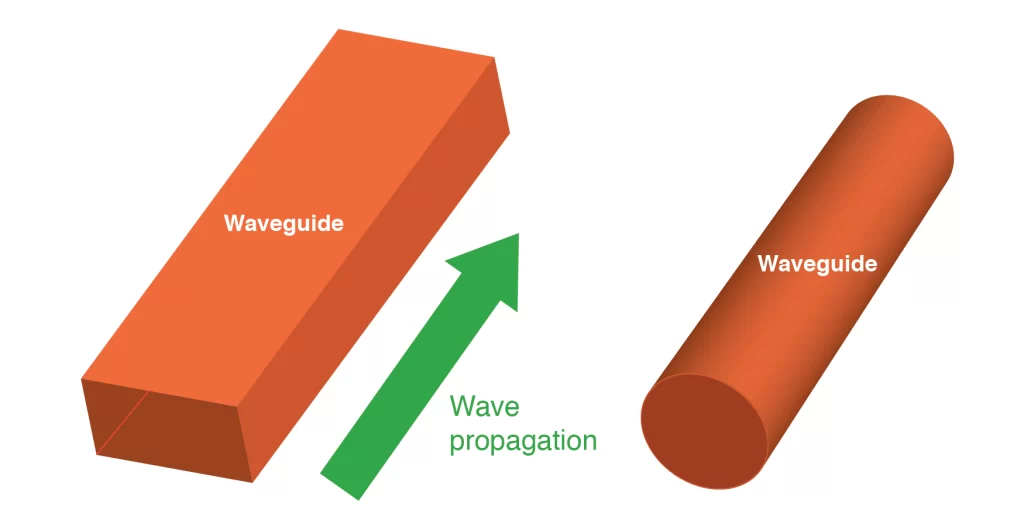
Square and circular waveguides differ in several key aspects. Square waveguides, with dimensions like 23 mm × 10 mm, support dual-polarization modes (TE10/TE01) but suffer 15% higher attenuation than circular ones (typically 0.1 dB/m at 10 GHz). Circular waveguides (e.g., 50 mm diameter) excel in low-loss long-distance transmission (0.08 dB/m) and handle higher power (30%

Square vs Circular Waveguide Differences | 5 Comparisons Read More »

Why use millimeter waveguide technology | 5 key benefits

Millimeter waveguide technology offers five key benefits: it enables ultra-high bandwidth (100+ Gbps) with low loss (0.03 dB/m at 60 GHz), supports compact waveguide sizes (e.g., 3mm for 90 GHz operation), provides 30% better signal integrity than coaxial cables above 40 GHz, allows efficient power handling (kW-level in E-band), and simplifies dense deployments due to

Why use millimeter waveguide technology | 5 key benefits Read More »

How to reduce waveguide loss | 5 effective techniques

Reduce waveguide loss by choosing the correct operating band, shortening the RF path, controlling internal surface condition, assembling compatible flanges and verifying the complete assembly with calibrated measurements. Start by separating attenuation from reflection: a good VSWR reading alone does not establish low insertion loss. What does “waveguide loss” include? In a metal waveguide, finite

How to reduce waveguide loss | 5 effective techniques Read More »

Conical waveguide applications | 5 common use cases

Conical waveguides are widely used in microwave and RF systems for impedance matching, achieving 90%+ energy transmission efficiency between mismatched components. They enable ultra-wideband radar (2-18 GHz) by minimizing signal reflection. In satellite communications, they reduce loss in Ka-band (26-40 GHz) feeds. Medical devices leverage them for precise RF ablation (6-10 MHz), while industrial systems

Conical waveguide applications | 5 common use cases Read More »

Preventing copper waveguide corrosion | 5 proven methods

To prevent copper waveguide corrosion, apply a 5-10 µm gold plating layer, which reduces oxidation while maintaining conductivity (resistivity <2.44 µΩ·cm). Nitrogen purging at 1-2 psi prevents moisture ingress, and desiccant packs (silica gel with <40% RH) are effective for sealed systems. Regular IPA (99% isopropyl alcohol) cleaning removes contaminants, while conductive silver epoxy (0.001

Preventing copper waveguide corrosion | 5 proven methods Read More »

Millimeter wave propagation challenges | 5 common issues

Millimeter wave (mmWave) propagation faces significant challenges due to high atmospheric absorption and sensitivity to obstacles. Oxygen absorption peaks at 60 GHz (15 dB/km), while rain attenuation can exceed 20 dB/km in heavy downpours. Building penetration losses range from 40-80 dB, requiring dense small-cell deployments (200-300m spacing). Beamforming alignment must maintain <1° precision for 28

Millimeter wave propagation challenges | 5 common issues Read More »

Rigid waveguide material selection | 4 criteria to use

When selecting rigid waveguide materials, consider conductivity, thermal stability, mechanical strength, and cost. Copper (5.8×10⁷ S/m conductivity) is ideal for low-loss applications but oxidizes above 150°C. Aluminum (3.5×10⁷ S/m) offers lightweight alternatives with 60% lower weight than brass. For high-power systems (e.g., radar), silver-plated brass reduces surface roughness to <0.1µm, cutting attenuation by 15%. Stainless

Rigid waveguide material selection | 4 criteria to use Read More »

Scroll to Top
Blank Form (#3)